 Mind
Market Structure · Basics
Sold, but Not Settled: How T+1 Changes Your Available Cash
Learn why a stock sale can appear in your balance before its cash settles, how T+1 works, and where cash-account trading violations can arise.
· 6 min read
You sell a stock on Monday morning. The shares disappear, the sale appears in your activity, and your account still looks ready for another trade.
Then a warning appears: some of that money has not settled.
Nothing has gone missing. A completed trade and a completed transfer are different events. Understanding that gap matters most when you trade more than once with the same pool of cash.
The fill happens first. Settlement follows.
Execution is the agreement to trade: a buyer and seller transact at a price. Settlement is the subsequent transfer of securities and payment.
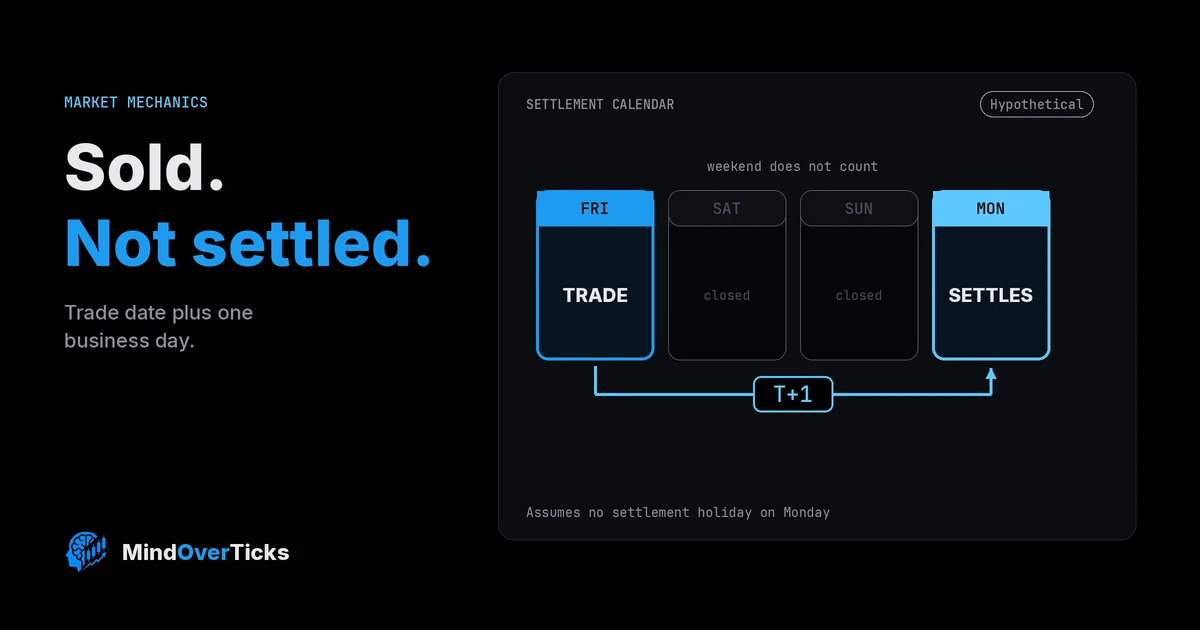
For most U.S. stock and ETF transactions, the standard cycle is T+1: trade date plus one business day. The change took effect on May 28, 2024. In a normal week, a Monday trade settles Tuesday. It does not mean exactly 24 hours after the fill. (SEC settlement bulletin)
That distinction gives an order two useful dates: when it traded, and when it settles. The first tells you what happened in the market. The second helps explain the funding behind the transaction.
If execution itself is unfamiliar, start with why an order can fill in pieces. Partial fills describe how an order executes; settlement describes what follows those executions.
Three balances that answer different questions
A cash account requires full payment for purchases; it does not provide a broker loan to fund them. (Investor.gov: cash accounts)
It helps to separate three questions, even when your broker uses different labels:
| What you want to know | What to look for |
|---|---|
| What is the account worth now? | Account value, including investments |
| What funding is already settled? | Settled cash and the cash committed to open orders |
| What will the broker permit me to buy? | Cash available to trade or buying power, with its conditions |
The third number needs its definition. Permission to place a purchase does not necessarily mean every dollar funding it has already settled.
Think of these as different views of the same account. Account value measures what you have. A settlement record explains when sale proceeds become settled funds. Trading availability reflects what the firm allows under its account rules.
For the exact meaning of a balance label, use the broker's help page or ask its support team. A green number is not an explanation of its funding conditions.
Follow the same $3,000 through two trades
Hypothetical example. This is a U.S. cash account with $3,000 of settled cash, no other holdings, no pending deposits and no other orders. Monday and Tuesday are ordinary business days. Ignore fees and assume each order fills completely at the stated price. The broker permits purchases funded partly by unsettled sale proceeds, subject to cash-account rules.
At 10 a.m. Monday, you buy 50 shares of fictional Stock A at $20:
50 × $20 = $1,000.
That purchase uses $1,000 of the original settled funds. There is $2,000 left uncommitted.
At noon, you sell all 50 shares at the same $20 price. The sale creates $1,000 of proceeds scheduled to settle Tuesday. The first purchase was fully funded by settled cash; selling it on Monday does not itself create the funding problem described below.
At this point, the account has $2,000 of unused settled cash and $1,000 of unsettled sale proceeds. The total is $3,000 again, but its funding status has changed.
| Monday event | Uncommitted settled cash | Uncommitted unsettled proceeds | Stock held |
|---|---|---|---|
| Start | $3,000 | $0 | None |
| Buy 50 A at $20 | $2,000 | $0 | $1,000 of A |
| Sell 50 A at $20 | $2,000 | $1,000 | None |
| Buy 100 B at $25 | $0 | $500 | $2,500 of B |
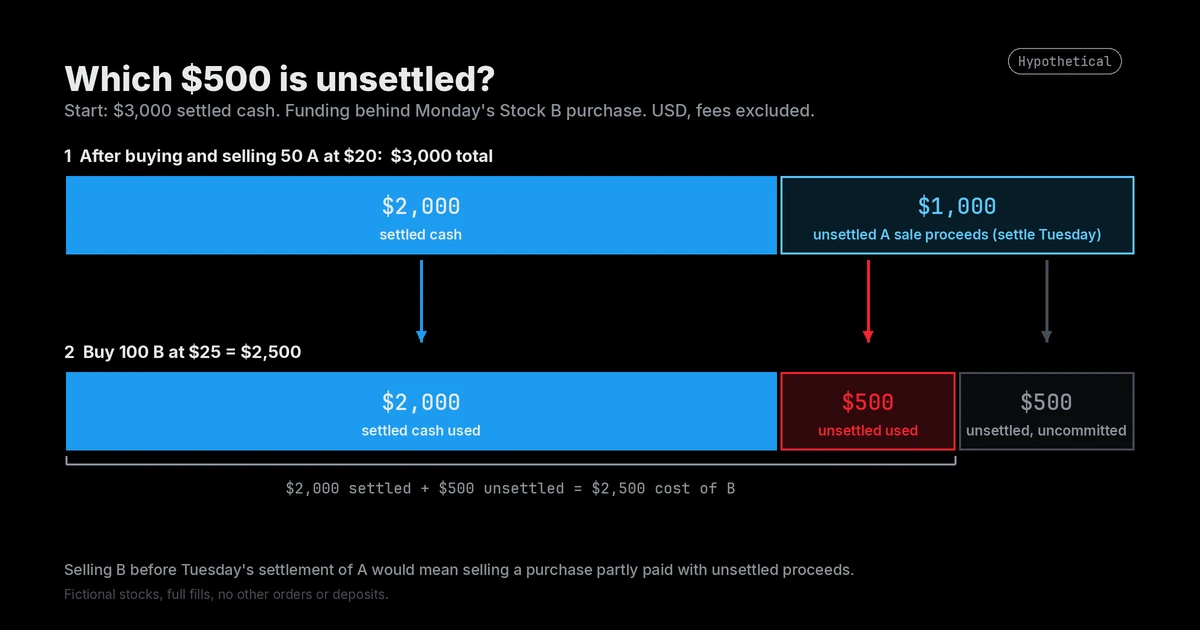
For the second purchase, 100 shares of fictional Stock B at $25 cost $2,500. Only $2,000 of unused settled funding remained. The other $500 depends on Stock A's sale settling Tuesday.
Another $500 of A's sale proceeds remains uncommitted. The table tracks funding allocations, not the precise labels or bookkeeping displayed by any brokerage app.
The crucial question now is not whether the second trade looks profitable. It is whether the money paying for it has settled.
Where a good faith violation enters
FINRA describes a good faith violation as buying with proceeds from an unsettled transaction, then selling the new security before the proceeds used to fund its purchase have settled. (FINRA cash-account guidance)
In this example, selling Stock B later on Monday would create that problem: $500 of its purchase depended on the still-unsettled sale of A. The unused $500 of unsettled proceeds does not turn into settled funding simply because it was left over.
Fidelity's published examples make the same distinction: a first purchase funded with settled cash can be sold, while a later purchase funded with those unsettled proceeds brings a new funding condition. (Fidelity's cash-trading examples)
This is why a profitable exit does not settle the question. A trading gain and a funding violation describe different parts of the transaction.
Freeriding is a related funding problem
Another term you may encounter is freeriding. In the specific example described by Fidelity, someone buys a security and uses the proceeds from selling that same security to pay for the purchase. That differs from the unsettled-proceeds chain above.
The SEC's investor education site explains that buying and selling before paying can lead to a 90-day cash-account freeze. During that period, purchases may still be possible, but full payment is required on the trade date. (Investor.gov)
Do not treat every warning as interchangeable or assume every firm applies the same operational restriction. Check the actual notice, the transaction history and the broker's written requirements. This article explains the mechanics; it cannot determine the status of a particular account.
A Friday sale follows a business-day clock
Under the standard cycle, a Friday stock sale normally settles Monday, assuming Monday is a settlement business day. If Monday is a settlement holiday, the next eligible business day comes later. Fidelity's settlement table and calendar note confirm that weekends and stock exchange holidays are not settlement days, and settlement typically does not occur on bank holidays even if exchanges are open.
| Trade date | Assumption | Normal settlement date |
|---|---|---|
| Monday | Tuesday is a settlement business day | Tuesday |
| Friday | Monday is a settlement business day | Monday |
| Friday | Monday is a settlement holiday; Tuesday is eligible | Tuesday |
A weekend is not two extra settlement days. A calendar reminder should follow business days, not a 24-hour countdown. For a real transaction, the settlement date on its confirmation is the useful starting point.
Build a small funding check into your routine
Before reusing sale proceeds, identify the transaction that produced them and its settlement date. Then check whether the proposed purchase uses settled cash, unsettled proceeds, or both.
If you keep a trading journal, an execution note can be short: “Funding: $2,000 settled + $500 from A sale; settles Tuesday.” That records a fact you can later reconcile with the confirmation.
If a warning appears, pause long enough to understand what it refers to. Ask the broker which transaction supplies the funds and what restriction applies to selling the new holding. Do not assume an order-entry screen has answered a question it never displayed.
What this explanation leaves out
This example covers ordinary U.S. stock trading in a cash account. It does not establish rules for futures, foreign markets, retirement-account features, every fund, or transactions with special settlement arrangements.
Settlement of a stock sale also does not establish when a new bank deposit clears or when money can be withdrawn. Those are separate operational questions for your broker.
A margin account brings different borrowing, collateral and trading requirements. It is not a simple fix for a cash-account warning. FINRA notes that borrowing to trade can produce losses beyond the amount initially deposited. (FINRA)
Settlement timing does not reduce market risk while you hold a security. Understanding the funding clock helps explain account permissions; it cannot make the price behave.
Further reading
For broader background on the brokers, market participants and order mechanisms surrounding execution, Larry Harris's Trading and Exchanges is a detailed market-microstructure reference. It predates today's T+1 regime, so use the current SEC, FINRA and broker guidance above for settlement requirements.
Disclosure: Some links are affiliate links. If you buy through them, MindOverTicks may earn a commission at no additional cost to you. As an Amazon Associate, MindOverTicks earns from qualifying purchases.
Trading and Exchanges — Larry Harris (Amazon)
Keep the two clocks separate
- A fill records a trade; settlement completes its securities-and-payment transfer.
- T+1 follows business days, rather than a fixed 24-hour timer.
- Track the funding behind a purchase, especially when reusing sale proceeds.
The next time an account looks ready for another trade, check which clock that balance is following.
Sources
- SEC: New T+1 Settlement Cycle — What Investors Need to Know
- FINRA: Frequent Intraday Trading — Understanding the Basics
- Investor.gov: Cash Account
- Fidelity: Avoiding Cash Account Trading Violations
- Fidelity: Placing Orders — Settlement Times by Security Type, footnote 2
Educational information only, not personalized financial or legal advice. Examples are hypothetical and exclude fees. Rules and broker procedures were checked on November 3, 2026. See the full Disclaimer.
Up next: Partial Fills: Why Your Order Can Execute in Pieces · Share on X · Follow @MOT_HQ