 Mind
Risk & Execution · Basics
Partial Fills: Why Your Order Can Execute in Pieces
Learn why stock orders fill in pieces, how to calculate an average fill price, and what limit prices and timing instructions mean for unfilled shares.
· 6 min read
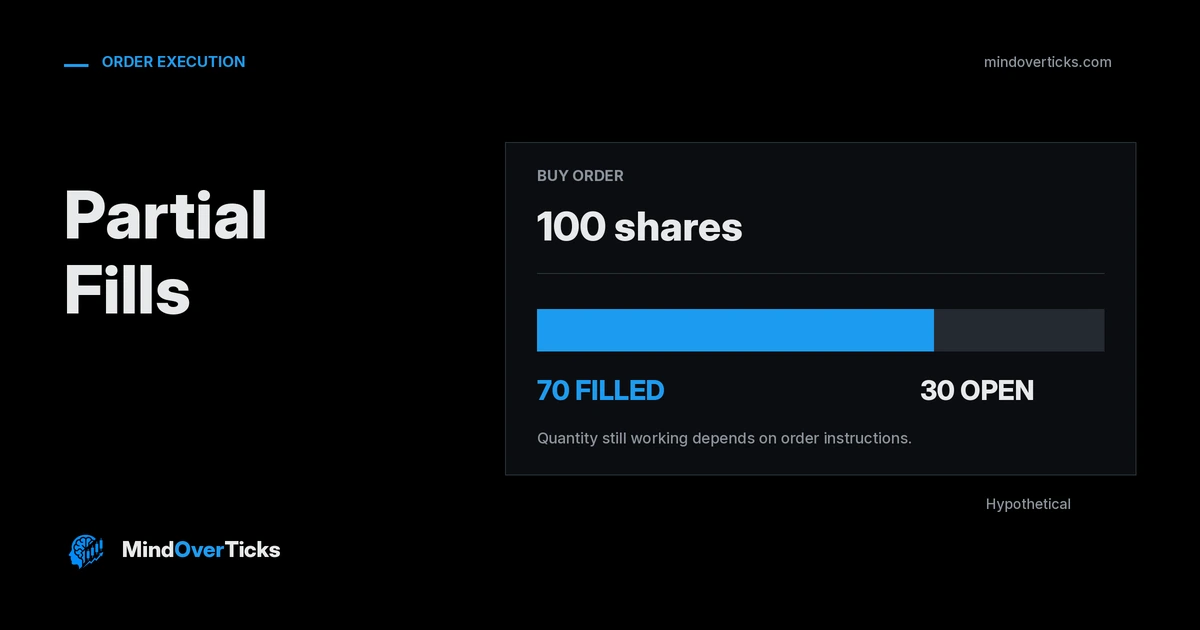
You asked to buy 100 shares. The screen says 70 filled.
That leaves you with two things at once: a 70-share position and, depending on the instructions, an order that may still buy another 30. The missing shares have not vanished. They are a separate part of the decision.
A partial fill means only some of an order's requested quantity has executed. Understanding it starts with a small distinction: an order is a request; a fill is a completed transaction.
One ticket can become several transactions
Imagine the price beside a stock is $50.00. That number does not promise that everyone can buy any quantity at $50.00.
The SEC explains that quotes apply to particular quantities and that prices can change while an order travels through the execution process. Your broker also determines where to route it. The market you see on screen is therefore a useful observation, not a reservation. Source: SEC, Executing an Order
For a buyer, an offer, also called an ask, is a price at which someone is offering shares. Depth describes the quantities available across prices. If there are not enough shares at one price, an order may execute in several pieces.
The SEC's order-type bulletin specifically notes that portions of a market order can fill at different prices. A limit order adds a price boundary: a buy limit permits that price or lower, while execution can remain incomplete. Source: SEC, Understanding Order Types
Follow a 100-share order through a small book
Everything in this example is hypothetical. It is a simplified snapshot, not an actual stock or a forecast. Assume the quantities below remain available, are accessible to the order, and are not taken by another order first. Ignore fees initially.
| Selling price per share | Shares available at that price |
|---|---|
| $50.00 | 30 |
| $50.02 | 40 |
| $50.05 | 50 |
There are 120 shares offered across these levels, but only 30 at the best displayed offer of $50.00.
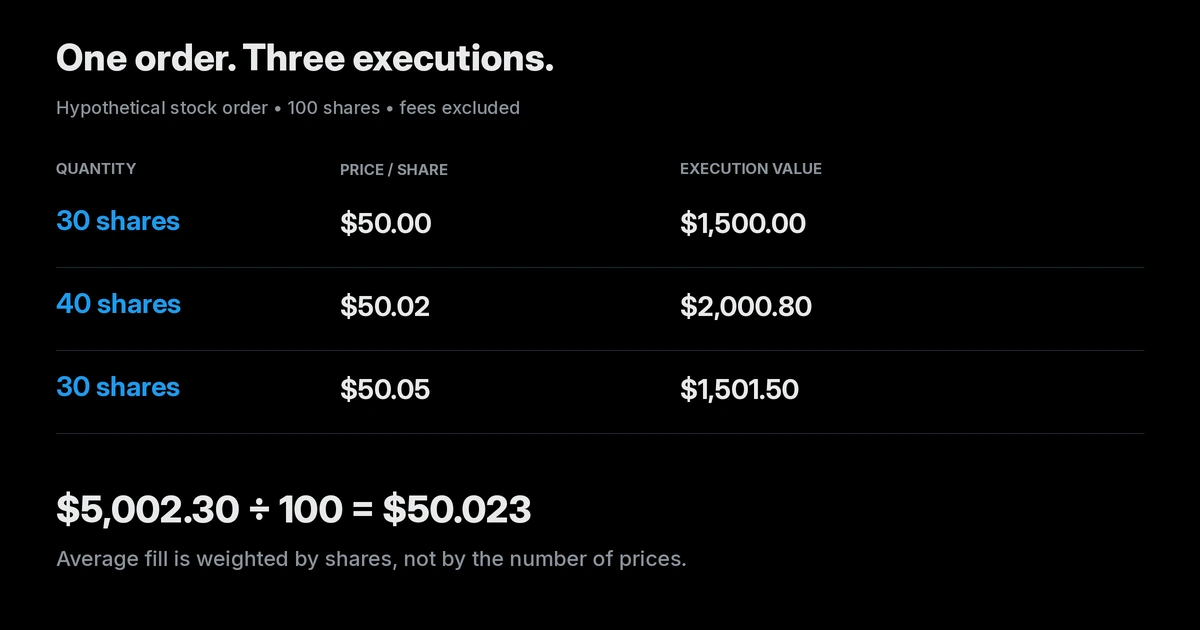
Suppose a 100-share buy order can execute across all three prices:
| Execution | Shares bought | Price per share | Dollars spent | Total shares filled |
|---|---|---|---|---|
| First | 30 | $50.00 | $1,500.00 | 30 |
| Second | 40 | $50.02 | $2,000.80 | 70 |
| Third | 30 | $50.05 | $1,501.50 | 100 |
| Total | 100 | — | $5,002.30 | 100 |
The third execution needs only 30 of the 50 shares at $50.05. Under these fixed assumptions, 20 shares remain at that price.
The order has filled completely, but not at one price. Its quantity-weighted average fill is:
Total execution value ÷ total shares = $5,002.30 ÷ 100 = $50.023 per share.
Weighting matters because the executions contain different quantities. Multiplying that average by 100 reproduces the actual $5,002.30 expenditure.
Buying every share at the initial $50.00 offer would have cost $5,000. The difference is $2.30 before fees. This comparison uses the initial offer as its benchmark; it is not a complete measure of trading costs or broker execution quality.
If this hypothetical transaction also had a $1 fee, the cash outlay would be $5,003.30. The execution-price average would still be $50.023; the cash cost per share including that assumed fee would be $50.033. Keep the two measures labeled rather than mixing them.
Now put a limit on the same order
Change only one instruction: buy 100 shares with a $50.02 limit.
In the same simplified snapshot, 30 shares can fill at $50.00 and 40 at $50.02. The remaining 30 cannot fill at $50.05 under that limit.
The result is:
- Filled: 70 shares.
- Execution value: $1,500.00 + $2,000.80 = $3,500.80.
- Average execution price: $3,500.80 ÷ 70 ≈ $50.01143.
- Unfilled: 30 shares.
The average sits below the limit because part of the order received a lower price. The limit applies to permitted execution prices; it is not an instruction to make the average equal $50.02.
Nothing in this example establishes that the remaining shares will fill later. The next question is how long that remainder is allowed to stay active.
Price and timing answer different questions
A price limit answers at what price? A timing or quantity instruction answers when, and must it all fill?
| Instruction | What it means for an incomplete order |
|---|---|
| Day | An unfilled balance generally expires at the end of the applicable trading day. |
| Good-til-canceled (GTC) | Can remain active beyond the day, subject to the broker's duration rules. |
| Immediate-or-cancel (IOC) | Takes an immediate available fill and cancels the remainder. |
| Fill-or-kill (FOK) | Requires immediate execution of the whole quantity; otherwise none executes. |
| All-or-none (AON) | Requires the whole quantity, but does not itself require immediate execution. |
Availability and exact handling vary by broker. These are the SEC's general descriptions, not a claim that every account supports every combination. Source: SEC, Understanding Order Types
For the 100-share limit example, an IOC instruction could leave 70 shares bought and 30 canceled. A regular day instruction could leave the same 70 shares bought with 30 still working. The initial position is identical; the remaining possibility is different.
The cancellation trap
Suppose 70 shares filled and you request cancellation of the last 30. Then you submit another order for 30, assuming the first remainder is gone.
If that original remainder fills before cancellation takes effect and the new order also fills, the arithmetic is:
70 already filled + 30 late original fill + 30 new fill = 130 shares.
You wanted 100.
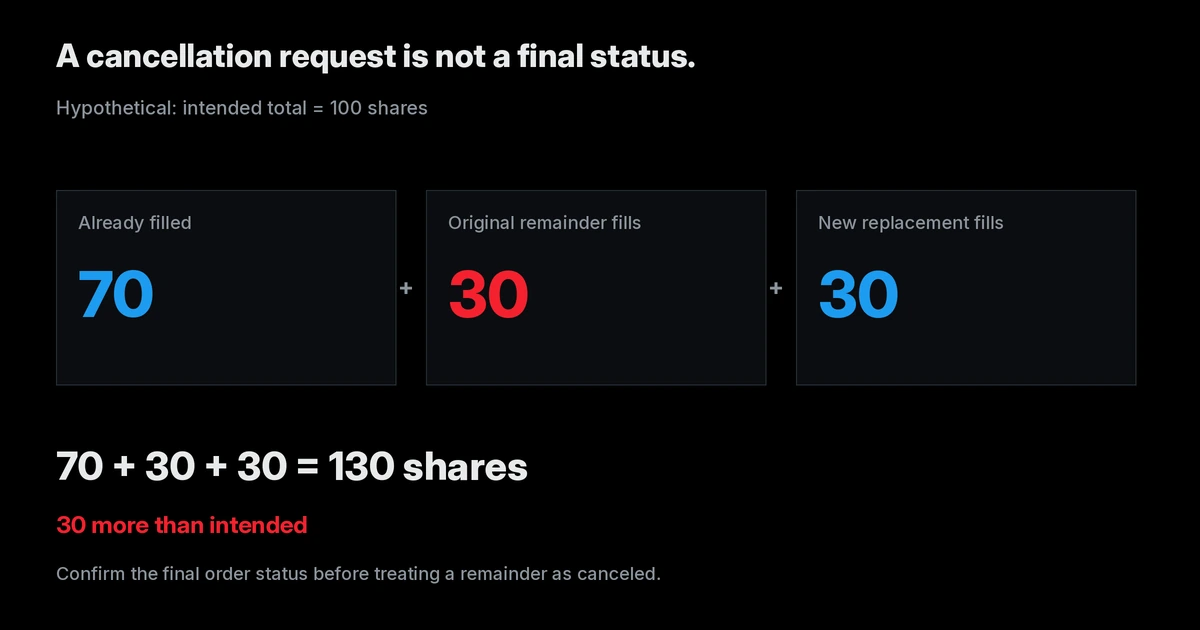
The SEC warns investors to confirm that cancellation actually worked and not to treat a receipt for a cancellation request as proof the transaction was canceled. It also cautions against repeating an order when execution status is uncertain. Source: SEC, Online Investing
This is why “cancel requested,” “canceled” and “filled” should not be read as interchangeable messages. Check the broker's actual order record and ask the firm when status is unclear.
Read the position and the remaining order together
After a partial fill, four entries deserve attention: filled quantity, average fill, remaining quantity and the remainder's current status.
Any exit instructions also need to be understood in relation to the position actually held and any entry quantity still working. Whether a platform automatically adjusts linked orders is a broker-specific feature; do not assume it from an illustration or another trader's screen.
For a reviewable record, add these to your trading journal:
- Original quantity, price instruction and timing instruction.
- Each execution's quantity and price, plus fees.
- The final disposition of every unfilled share: filled later, canceled or expired.
That record helps distinguish a decision made before entry from a response to an incomplete fill. The 1% rule lesson provides the related account-risk context; an intended position and an actual position should not quietly become the same number in your notes.
What the snapshot leaves out
This example freezes a market that does not normally stand still. Orders can change while yours is being handled, and a single display is not a complete map of everything your broker may access.
It also does not describe exchange-specific allocation rules, auctions, fractional-share handling or how a particular broker manages linked orders. Those details require the relevant broker and venue documentation. The discussion concerns common stock-order mechanics; it should not be copied unchanged to every futures, options or crypto platform.
A partial fill is not, by itself, evidence that an order malfunctioned or that a trade was poorly executed. It tells you that requested quantity and completed quantity differ. Explaining why requires the order instructions and execution record.
Keep the two quantities separate
- The quantity entered on a ticket is not the quantity already owned.
- Several executions need a quantity-weighted average, not an average of price labels.
- A price limit and an instruction governing the remainder solve different problems.
- An unfilled balance remains something to track until its final status is known.
The useful habit is simple: whenever an order fills in pieces, account for both the piece you have and the piece that can still change.
Sources
- U.S. Securities and Exchange Commission, Investor.gov. Executing an Order. investor.gov
- U.S. Securities and Exchange Commission, Investor.gov. Investor Bulletin: Understanding Order Types. investor.gov
- U.S. Securities and Exchange Commission, Investor.gov. Online Investing. investor.gov
Educational information, not personalized investment advice. All order-book quantities, prices, fees and calculations above are hypothetical. See the full Disclaimer.
Up next: How to Keep a Trading Journal You'll Actually Use · Share on X · Follow @MOT_HQ