 Mind
Selden's 1912 Psychology of the Stock Market, Scored
Educational only, not financial advice (disclaimer).
By Mind Over Ticks editorial team
This post contains an affiliate link. We earn a commission if you buy through it.
“The greatest fault of ninety-nine out of one hundred active traders is being bullish at high prices and bearish at low prices.” George C. Selden wrote that in 1912, in Psychology of the Stock Market.
It gets quoted as proof he saw behavioral finance coming. We scored ten of his claims against research we could read.
The book is free at Project Gutenberg.
The Psychology of the Stock Market scorecard
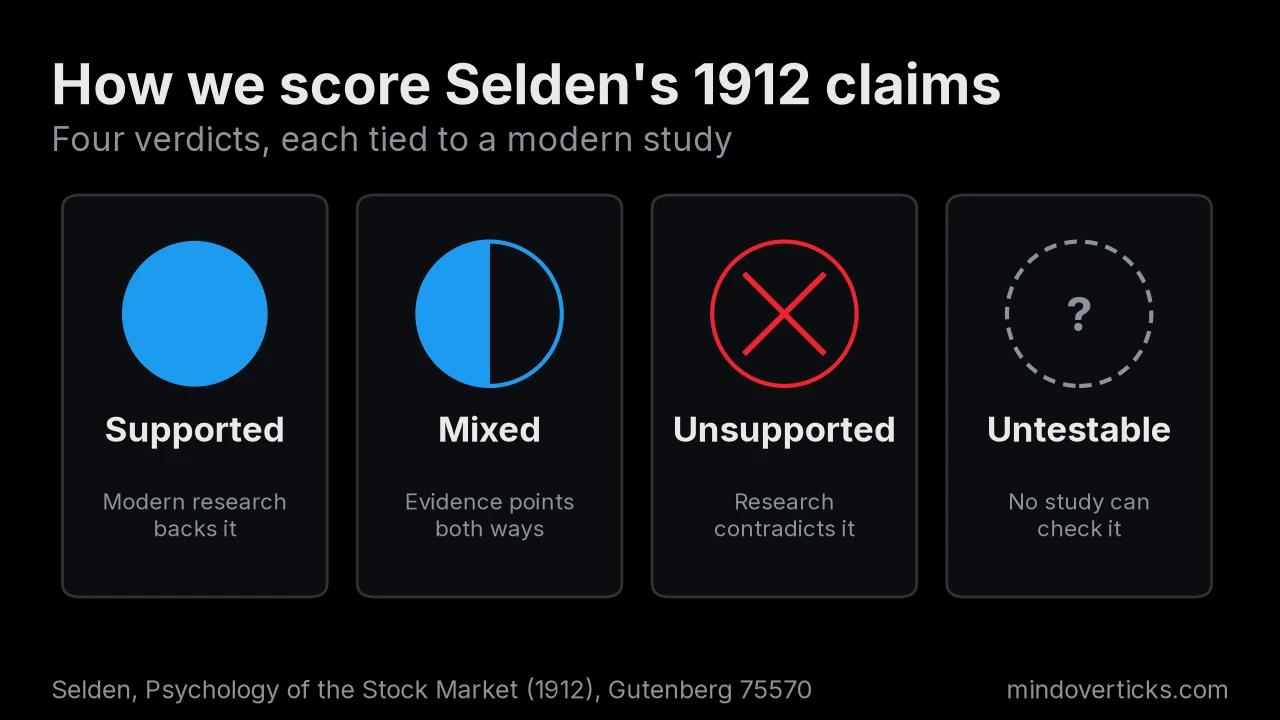
| # | Selden’s claim | His words | Verdict | Evidence |
|---|---|---|---|---|
| 1 | Traders judge by their entry price and their P&L | “forget entirely his own position in the market, his profits or losses, the relation of present prices to the point where he bought or sold” (Ch. V) | Supported | Odean 1998; Kahneman and Tversky 1979 |
| 2 | Traders are overconfident in their own analysis | “confident that his own analysis of the situation will prove correct” (Ch. II) | Supported | Barber and Odean 2001 |
| 3 | Logic serves desire once you hold a position | “many seem to think that logic was given us for the purpose of backing up our desires” (Ch. V) | Supported | Kunda 1990 (general psychology, not a trading study) |
| 4 | People assume the present will continue | “It is a sort of automatic assumption of the human mind that present conditions will continue” (Ch. IV) | Supported | Greenwood and Shleifer 2014 |
| 5 | Traders are bullish at highs and bearish at lows | “The greatest fault of ninety-nine out of one hundred active traders is being bullish at high prices and bearish at low prices.” (Ch. VIII) | Mixed | Greenwood and Shleifer 2014 |
| 6 | News causes one price move, not two | “an item of news usually causes but one considerable movement of prices” (Ch. II) | Mixed | Daniel, Hirshleifer and Subrahmanyam 1998 (model) |
| 7 | Only experienced traders may trust a hunch | “Only the experienced trader is entitled to a “hunch.”” (Ch. VIII) | Mixed | Kahneman and Klein 2009 |
| 8 | When in doubt, stay out | “When in doubt, keep out of the market. Delays cost less than losses.” (Ch. VIII) | Supported | Barber and Odean 2000 |
| 9 | The public has outgrown its errors | “This wrongheadedness of the public no longer exists to the same extent as formerly.” (Ch. V) | Unsupported | Odean 1998; Barber and Odean 2000 |
| 10 | Any emotion clouds judgment | “Any emotion” … “will only cloud the intellect.” (Ch. VIII) | Untestable | Lo and Repin 2002 |
Selden italicized “one” in claim 6 and “in” in claim 1. Claim 10 is shortened where Selden lists “enthusiasm, fear, anger, depression”.
Where Selden was right
Claim 1: the entry price grips you. Selden recalled one broker telling another: “Get them out with a small profit … If you don’t they will hang on and take a loss.”
Odean’s study of 10,000 discount brokerage accounts found “a strong preference for realizing winners rather than losers,” adding: “Nor is it justified by subsequent portfolio performance” (Odean 1998). Prospect theory, judging outcomes as gains or losses from a reference point, came later (Kahneman and Tversky 1979).
Selden also cut the other way, about traders who hope for large profits: “After five points in their favor, they hope for ten,” and after that, more. He held both views.
Claim 2: everyone else is wrong, except me. In over 35,000 households from 1991 to 1997, Barber and Odean found men traded 45% more than women. Trading cut men’s net returns by 2.65 percentage points a year, against 1.72 for women, consistent with overconfidence (Barber and Odean 2001).
Claim 3: logic serves desire. Kunda’s review of motivated reasoning found that “people are more likely to arrive at conclusions that they want to arrive at,” limited by their ability to build “seemingly reasonable justifications” (Kunda 1990).
Claim 4: the present will continue. Greenwood and Shleifer studied investor expectations from six data sources between 1963 and 2011 and found them “highly positively correlated … with past stock returns” (Greenwood and Shleifer 2014).
Claim 8: when in doubt, keep out. Across 66,465 households from 1991 to 1996, those that traded most earned 11.4% a year, against 17.9% for the market (Barber and Odean 2000). That fits a “trade less” reading.
Where the evidence is mixed
Claim 5: wrong at the extremes. The same Greenwood and Shleifer expectations were “strongly negatively correlated with model-based expected returns.” That fits optimism peaking after rises, but “ninety-nine out of one hundred” is a number nobody measured.
He also contradicts himself: rule 4 says “Endeavor to catch the trend of sentiment.”
Claim 6: one move per news item. A model by Daniel, Hirshleifer and Subrahmanyam predicts short-run “drift” and momentum after news, meaning prices keep moving (Daniel, Hirshleifer and Subrahmanyam 1998).
Claim 7: the experienced trader’s hunch. Kahneman and Klein concluded that “Subjective experience is not a reliable indicator of judgment accuracy” (Kahneman and Klein 2009).
Where he was wrong
Claim 9: the public has learned. Decades later, Barber and Odean’s retail households still traded heavily and lost return by doing so, and Odean’s still sold winners and held losers.
What cannot be scored
Claim 10: “any emotion.” Selden wanted the trader as calm as “a mountain lake on a calm day.” A study of 10 professional traders found statistically significant physiological responses during market events and volatile periods (Lo and Repin 2002). Emotion is present in pros, but not shown to always hurt. As worded, the claim is unmeasurable.
Limits
- “Supported” means modern evidence agrees with Selden, not that he discovered the effect. A 1913 review said the book made “no attempt at working out a causal organic theory” (JPE review, 1913).
- Selden wrote about NYSE speculators around 1900; most evidence here is from US retail households in the late 1980s and 1990s.
- Claims 4 and 5 rest on one paper, read in abstract only, and it measures expectations, not trades. Claim 6 rests on a model, not a test. Barber and Odean 2001 uses trading as a stand-in for confidence.
- Claim 8’s study does not test Selden’s position-size line, “do not trade so heavily as to become anxious.”
- Two claims (market writers, panic lows) were dropped: we could not read a study testing them.
Further reading
Annie Duke’s Thinking in Bets is a book on decision making under uncertainty. See it on Amazon (affiliate link). As an Amazon Associate we earn from qualifying purchases.
Related: Kelly sizing from a short backtest.
How this was made: researched and drafted with AI tools from cited sources, then fact-checked and edited under our editorial standards. See our Editorial Process page.
Mind Over Ticks publishes general education, not personalized investment advice. We do not know your situation. Talk to a licensed professional before acting. Nothing here is a trading rule or a recommendation.