 Mind
Revenge Trading: The Trade After the Bad Trade, and a Reset Routine
Educational only, not financial advice (disclaimer).
Just starting out? Revenge trading is the trade we take to “get it back” right after a loss. It isn’t part of the plan. It’s driven by the sting of the last trade, and in our experience it tends to come bigger, faster and sloppier than our normal trades.
Almost every trader has done it at least once. We have. The good news is that it follows a pattern, and patterns can be interrupted. Let’s walk through a story, look at what research says about how losses change our risk taking, and then build a simple reset routine.
A hypothetical Tuesday
This story is hypothetical, a composite of a very common experience.
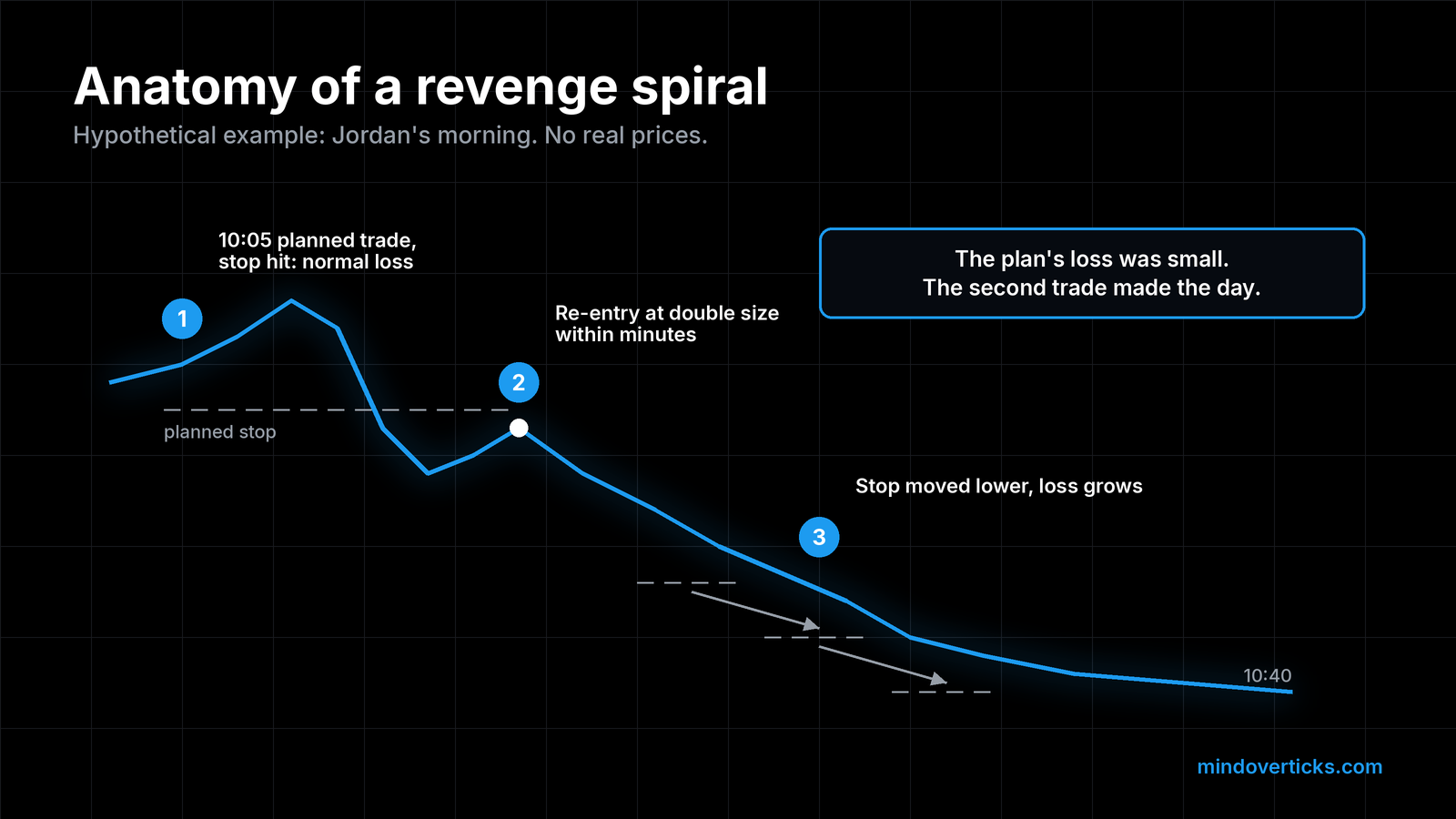
Jordan trades index futures. His rule is one contract and a fixed stop. At 10:05 AM he takes a clean long setup. Price ticks his way, then reverses on a headline and runs straight through his stop. A full loss, but a normal one. The plan allowed for it.
Here’s where it turns. Jordan stares at the chart. “That was a stupid headline. The level still holds.” Ninety seconds later he’s long again, this time with two contracts, “just to make it back faster.” He moves his stop a little lower, “to give it room.” Price drifts lower. He moves the stop again.
By 10:40, one small planned loss has turned into a much bigger unplanned one, and the day is a mess. Jordan isn’t a bad trader. He had a bad second trade, and it was the second trade that hurt him.
What the research says
Losses can make us take more risk, not less
We might expect a loss to make us careful. Often it does the opposite. Richard Thaler and Eric Johnson ran real money experiments on how prior gains and losses change risky choices. The abstract reports “break-even effects”: in the presence of prior losses, outcomes that offer a chance to break even are especially attractive (Thaler and Johnson, 1990). It also reports a “house money effect,” meaning increased risk seeking after a prior gain.
That’s Jordan’s second trade in a sentence. The bigger size wasn’t about the setup. It was about getting back to zero.
Professional traders do it too
This isn’t only a beginner problem. Joshua Coval and Tyler Shumway studied proprietary traders at the Chicago Board of Trade. The abstract reports that traders who experienced morning losses were about 16 percent more likely to assume above-average afternoon risk than traders with morning gains (Coval and Shumway 2001, “Do Behavioral Biases Affect Prices?”). It also reports that losing traders were prepared to buy at higher prices and sell at lower prices than had prevailed before, and that prices then reverted strongly in the following ten minutes.
Put plainly, the trades made after a loss tended to be made at worse prices. These were professional traders, which tells us skill alone doesn’t switch the pattern off.
Big emotional swings and performance
Andrew Lo, Dmitry Repin and Brett Steenbarger studied 80 day traders, using daily emotional-state surveys over five weeks. The abstract reports that traders whose emotional reaction to monetary gains and losses was more intense, on both the positive and negative side, had significantly worse trading performance (Lo, Repin and Steenbarger, NBER Working Paper 11243). This is a correlation in one sample, so it doesn’t prove that emotion caused the losses. But it points to the same place: the size of our reaction matters.
Emotions can be managed at more than one point
Here’s the hopeful part. Psychologist James Gross describes a process model in which, the abstract reports, emotion can be regulated at five points: selecting the situation, modifying the situation, deploying attention, changing our thinking, and modulating our response (Gross, 1998). We don’t have to win the fight at the last second, with a finger over the buy button. We can set things up earlier so the fight is smaller.
The reset routine
The routine below is our own, mapped loosely onto those five points. It’s a starting template, not a guarantee and not investment advice. Each of us can adjust it to our own plan.
Before the session (choose and shape the situation)
- Write a daily loss limit and a “two losses, then pause” rule into the plan.
- Decide in advance that size never goes up after a loss on the same day.
Right after a loss (change the situation)
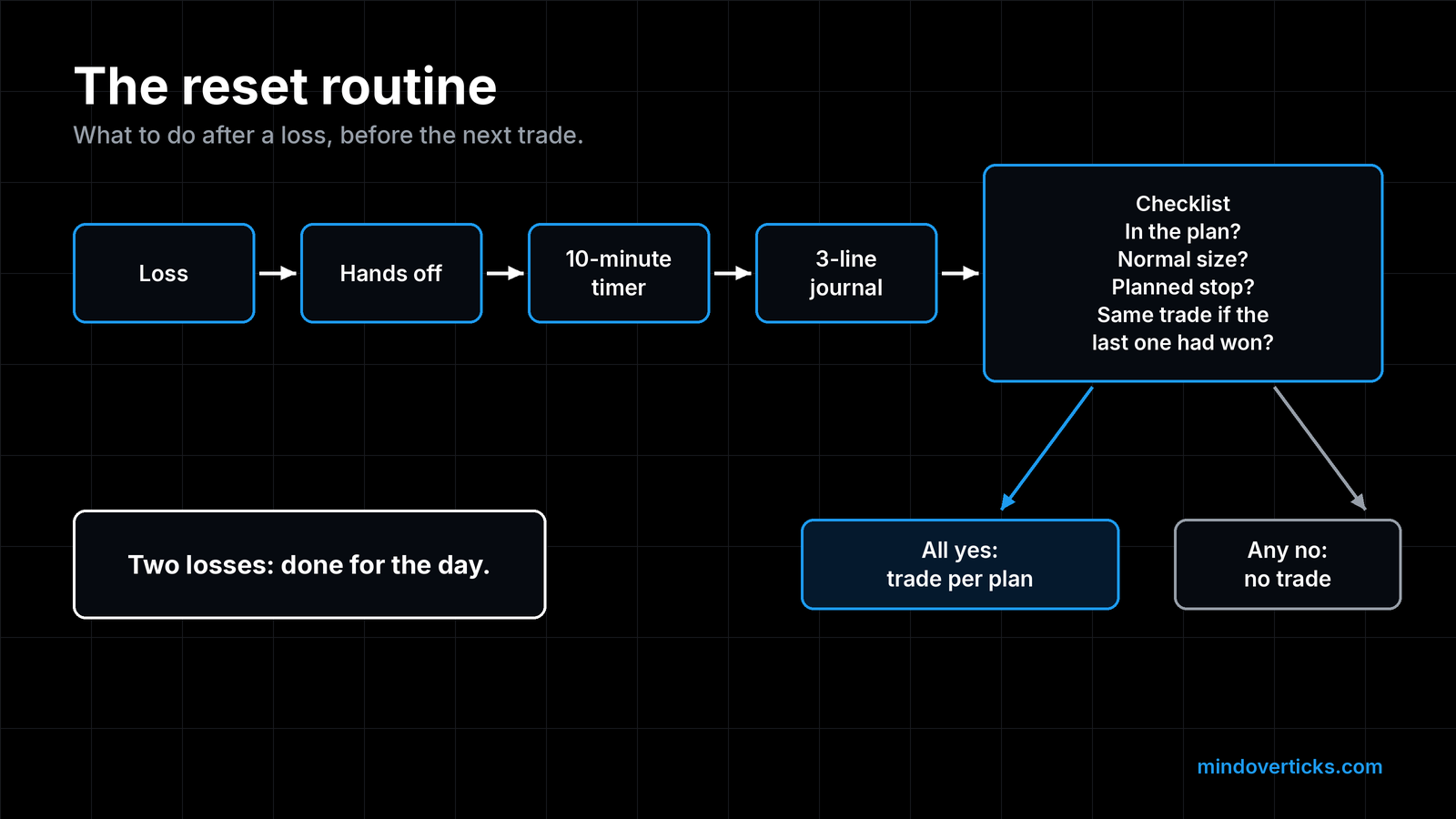
- Hands off the mouse. Stand up. Set a timer for ten minutes. The number isn’t magic; the point is a real gap between the loss and the next decision.
- If the platform allows it, flatten and close the order ticket so re-entry takes deliberate steps.
During the pause (move attention, then rethink)
- Look away from the chart that just stung. Breathe, drink water, walk.
- Then write three lines in the journal: what happened, whether we followed the plan, and what we feel right now. “Followed the plan, took a normal loss, feel angry” is a perfectly good entry.
- Reframe: the loss was the cost of a valid trade, not a debt the market owes us.
Before the next trade (check the response)
- Run a short checklist. Is this setup in the plan? Is the size our normal size? Is the stop where the plan puts it? Would we take this trade if the last one had been a winner?
- If any answer is no, there is no trade. If the pause rule is hit, the day is done.
After the session
- Review any trade taken within a short window after a loss. Over a few weeks, compare those trades with the rest. Our own numbers will be more convincing than any article.
Taking the pause is a win worth counting, the same way skipping a trade is. Our post on the trades we don’t take tells that story.
So here’s our question for you: what’s your own signal that the next trade is a revenge trade, and what helps you step away? Tell us in the replies.
Mind Over Ticks publishes general education, not personalized investment advice. We do not know your situation. Talk to a licensed professional before acting. Nothing here is a trading rule or a recommendation.
Drafted with AI assistance, then fact-checked and edited by the Mind Over Ticks team.
Up next · 6 minFOMO in Trading: Why the Move You Missed Stings, and What to Do Next Time