 Mind
Patience Pays: The Trades You Don't Take
Educational only, not financial advice (disclaimer).
Some of our best trading days look like nothing happened. No big win. No screenshot. Just a plan, a screen and a lot of waiting.
That can feel like failure. We sat there for hours and didn’t “do” anything. But a trade we skip on purpose is still a decision, and often a good one.
So let’s spend a day together. One trader, which is us, one plan, and a lot of chances to click when we shouldn’t.
This whole story is hypothetical. The trader is us, the day is made up, and there are no real stocks or prices in it.
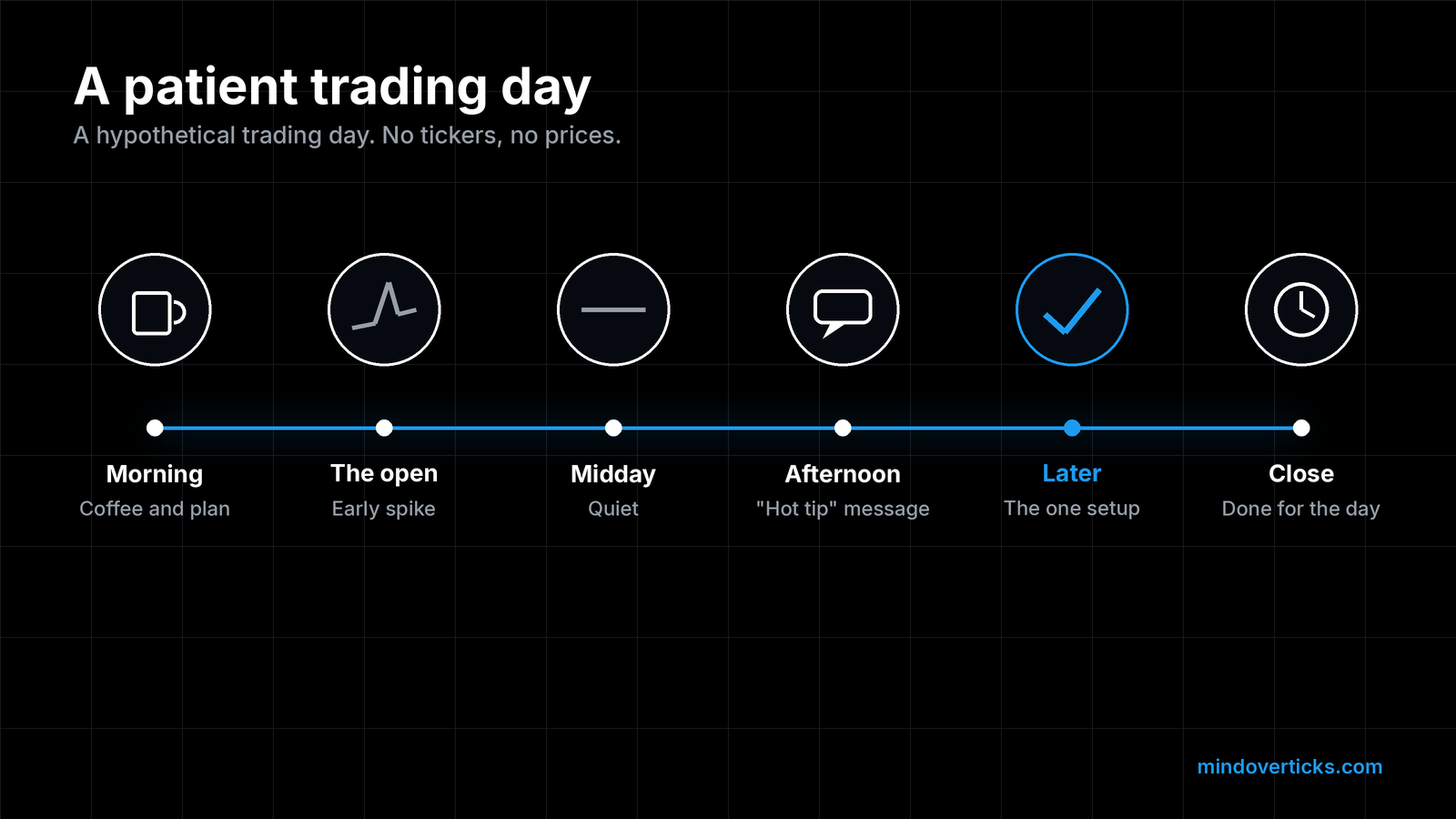
Morning: the plan
Before the open, we write down one thing: the setup we’re waiting for. Where we’d get in, where we’d get out if we’re wrong, and how much we’d risk. If we’re fuzzy on reading the bars that will show us that setup, our guide to what a candlestick actually tells you is a good warm up.
We also write the rule that matters most today: if it isn’t the setup, we don’t take it.
That’s the whole plan. It fits on a sticky note.
The open: the first temptation
The bell rings and a stock we watch jumps fast. Green bars, big ones. Every part of us wants in.
But it’s not our setup. It’s just exciting.
We feel it, that little “what if this runs and I’m not in it” itch. We let it itch. We don’t click.
Ten minutes later it has given back a chunk of the move. We didn’t know it would. We just knew it wasn’t ours.
Midday: the long, boring middle
Now nothing happens. For a long time.
This is the hard part, honestly. Boredom makes us want to “find” a trade. We start squinting at charts that don’t fit, telling ourselves this one is “close enough.”
So we stand up. Refill the water. Re-read the sticky note. Close a few tabs.
Nothing humbles a trader faster than a trade taken just because the afternoon felt slow. We’ve been there. Today we’re not.
Early afternoon: the hot tip
A message pops up from a chat group: something “about to move.” There’s no plan behind it. Just urgency.
We notice the pull, and we notice that it’s someone else’s idea. Not our setup, not our risk. We mute the chat for the rest of the session.
Late afternoon: the one that fits
Then, finally, it shows up. The setup from the sticky note. Entry, exit if wrong, and size all line up with what we wrote this morning.
We take it, with the order type we planned. (If we’re still deciding between market, limit and stop orders, our order types guide walks through what each one costs.)
Will it work? We don’t know. One trade never tells us much. What we do know is that it was the right kind of trade to take, and it was the only one.
The close: a quiet win
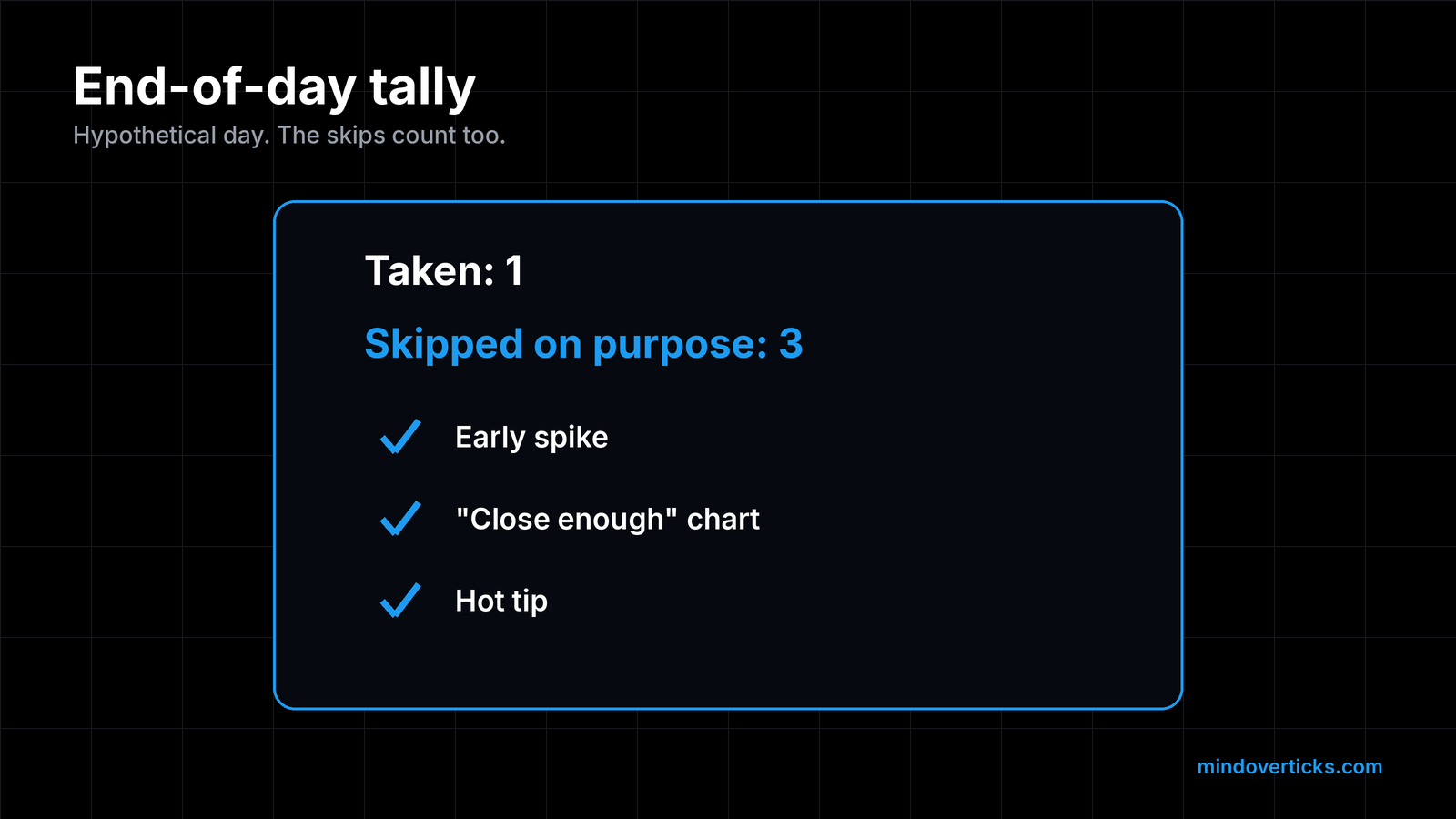
At the end of the day we count. One trade taken. Three skipped on purpose: the early spike, the “close enough” chart and the hot tip.
That’s the win we want to celebrate. Not the outcome of one trade, but the fact that we followed the plan through every temptation the day threw at us.
What the research says about trading less
Our story is made up. The pattern behind it isn’t.
Brad Barber and Terrance Odean studied real brokerage accounts. The abstract of their paper says: “Of 66,465 households with accounts at a large discount broker during 1991 to 1996, those that trade most earn an annual return of 11.4 percent, while the market returns 17.9 percent” (Barber and Odean 2000).
And the households that traded least? The paper reports that “an investment that mimicked the low turnover quintile would have earned 18.5 percent” (Barber and Odean 2000). Those are net returns, after trading costs.
Interestingly, it wasn’t that frequent traders picked worse stocks before costs. The authors found “very little difference in the gross performance of households that trade frequently” and those that trade infrequently (Barber and Odean 2000). The extra trading itself, and what it cost, made the gap.
Why do people trade so much? Their answer: “Overconfidence can explain high trading levels and the resulting poor performance of individual investors. Our central message is that trading is hazardous to your wealth” (Barber and Odean 2000).
In an earlier paper, Odean also checked whether trades with good reasons behind them changed the picture. They mostly didn’t: “Even after eliminating most trades that might be motivated by liquidity demands, taxloss selling, portfolio rebalancing, or a move to lower-risk securities, trading still lowers returns” (Odean 1999). (“taxloss” is as printed.)
What this does and doesn’t show
A fair word of caution, because we want to read this honestly:
- These were mostly stock investors at one discount broker in 1991 to 1996, not day traders today.
- The research is about how much people traded, not about patience as a skill or waiting for a setup.
- So the link from “trade less” to “wait for your setup” is our view, not something the paper tested.
Still, it’s a comforting finding. The trades we don’t take aren’t wasted time. In this data, doing less was the more profitable habit.
A small habit to try
Here’s one we like. Next session, keep a tally of the trades we skip on purpose, with one line each on why. “Not my setup.” “Just bored.” “Someone else’s tip.”
At the end of the week, read the skip list. It’s often more interesting than the trade list, and it’s a real record of discipline, the kind that doesn’t show up in a P&L screenshot.
If the early spike is the hardest one to let go, our post on FOMO in trading has a plan for next time. And if the urge to click shows up right after a loss, revenge trading walks through a simple reset routine.
So here’s our question for you: what’s the hardest kind of trade for you to skip, the early spike, the boring afternoon, or the hot tip? Tell us in the replies.
Mind Over Ticks publishes general education, not personalized investment advice. We do not know your situation. Talk to a licensed professional before acting. Nothing here is a trading rule or a recommendation.
Drafted with AI assistance, then fact-checked and edited by the Mind Over Ticks team.
Up next · 6 minRevenge Trading: The Trade After the Bad Trade, and a Reset Routine