 Mind
Market, Limit and Stop Orders: Which One to Use, and What Each One Costs You
Educational only, not financial advice (disclaimer).
We’ve all stared at that order ticket the first time. Market? Limit? Stop? Stop limit? It feels like a pop quiz nobody warned us about.
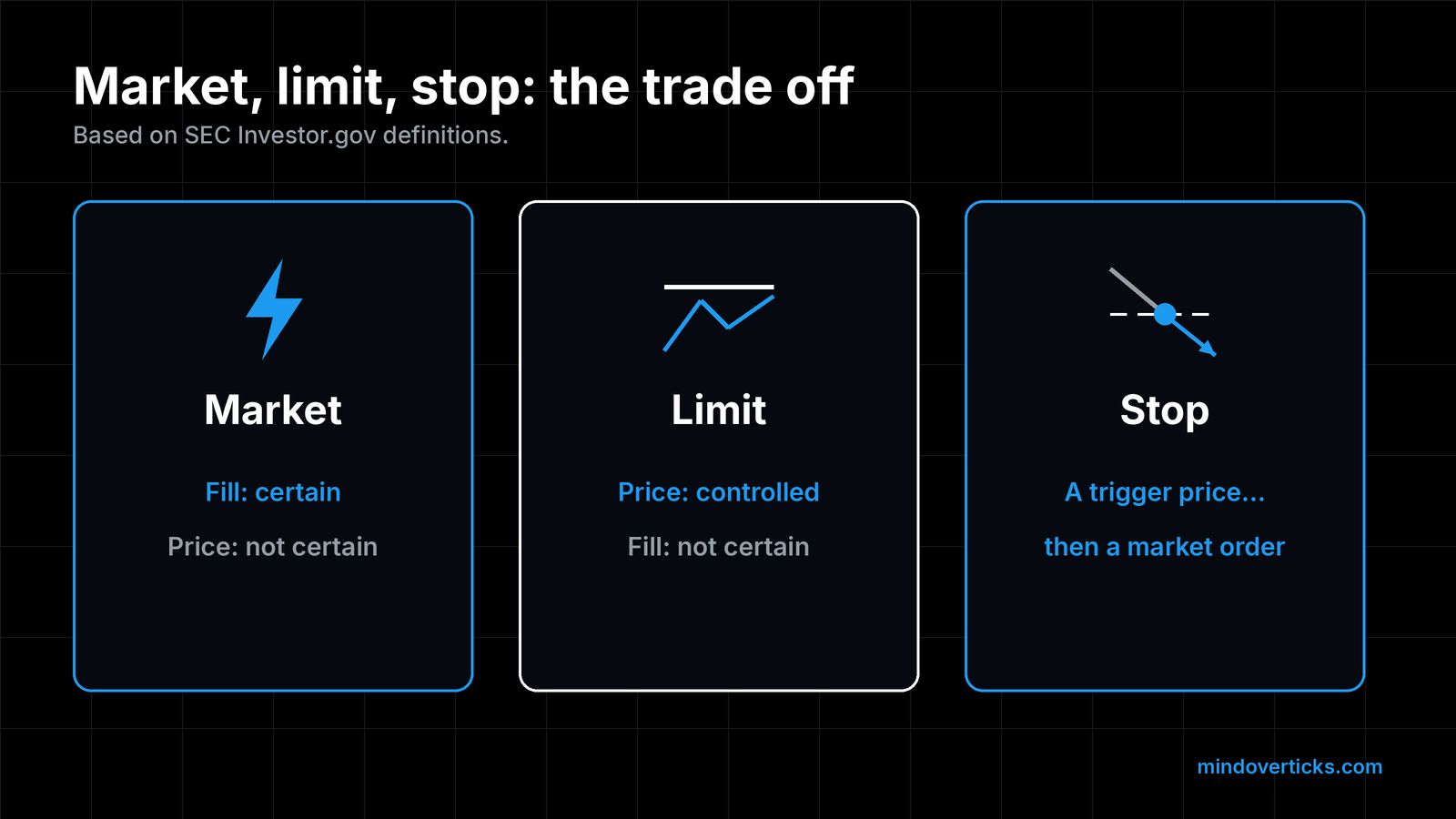
Here’s the friendly version. Each order type is a trade off. One gives us certainty that we get filled. One gives us control over the price. One waits quietly in the background until a price we picked gets hit.
None of them is free. Each one has a cost, and once we can see the cost, picking the right order gets a lot easier.
First, two prices we always see: the bid and the ask
Before any order, it helps to know the two prices on our screen. Investor.gov explains that “The term ‘bid’ refers to the highest price a buyer will pay to buy a specified number of shares of a stock at any given time. The term ‘ask’ refers to the lowest price at which a seller will sell the stock” (Investor.gov).
And the gap between them? “The difference between the bid price and the ask price is called the ‘spread’” (Investor.gov).
Keep the spread in mind. It shows up again in a minute.
Market orders: “just get me in”
Investor.gov’s definition: “A market order is an order to buy or sell a security immediately. This type of order guarantees that the order will be executed, but does not guarantee the execution price” (Investor.gov).
So we’re trading price for certainty. The same page adds that a market order “generally will execute at or near the current bid (for a sell order) or ask (for a buy order) price.”
That’s the first cost. If we buy at the ask and the bid is a bit lower, we’ve already paid the spread the moment we’re in.
Hypothetical example (made-up prices): a stock shows a bid of $20.00 and an ask of $20.05. A market buy fills at about $20.05. If we sold right back with a market order, we’d get about $20.00. That 5 cent gap per share is the spread, and on 100 shares it’s about $5 (our math), before the price moves at all.
The second cost: the price we see isn’t always the price we get. “It is important for investors to remember that the last-traded price is not necessarily the price at which a market order will be executed” (Investor.gov).
The SEC’s investor bulletin goes further: “parts of a large market order may execute at different prices due to lack of liquidity at a price at the time of execution” (Investor.gov bulletin). Traders often call that difference between the price we expected and the price we got “slippage” (our word for it, not the SEC’s).
Limit orders: “only at my price”
“A limit order is an order to buy or sell a security at a specific price or better. A buy limit order can only be executed at the limit price or lower, and a sell limit order can only be executed at the limit price or higher” (Investor.gov).
Now we have control. We’ll never pay more than our limit on a buy.
The cost is quieter, but it’s real: we might not get filled at all. In the SEC’s words, “A limit order is not guaranteed to execute. A limit order can only be filled if the stock’s market price reaches the limit price” (Investor.gov bulletin).
Hypothetical example (made-up prices): we place a buy limit at $19.90 while the stock trades at $20.05. It dips to $19.95, turns around, and climbs to $21. Our order never fills. We saved nothing and we’re not in the trade. Raise your hand if that one has stung.
That’s the honest trade off. A limit order protects our price and costs us certainty.
Stop orders: “if this happens, get me out (or in)”
A stop order waits. Investor.gov: “When the stop price is reached, a stop order becomes a market order” (Investor.gov). The bulletin explains the two directions: “A sell stop order is entered at a stop price below the current market price. Investors generally use a sell stop order to limit a loss or to protect a profit on a stock that they own” (Investor.gov bulletin).
The part that surprises a lot of us: the stop price is a trigger, not a promise. “The stop price is not the guaranteed execution price for a stop order. The stop price is a trigger that causes the stop order to become a market order” (Investor.gov bulletin).
Because it turns into a market order, it carries the market order’s costs. The SEC’s glossary says “the price at which your trade is executed may differ from the stop price, especially in a fast-moving market where stock prices can change rapidly” (Investor.gov). The bulletin puts it more bluntly: the fill “can deviate significantly from the stop price.”
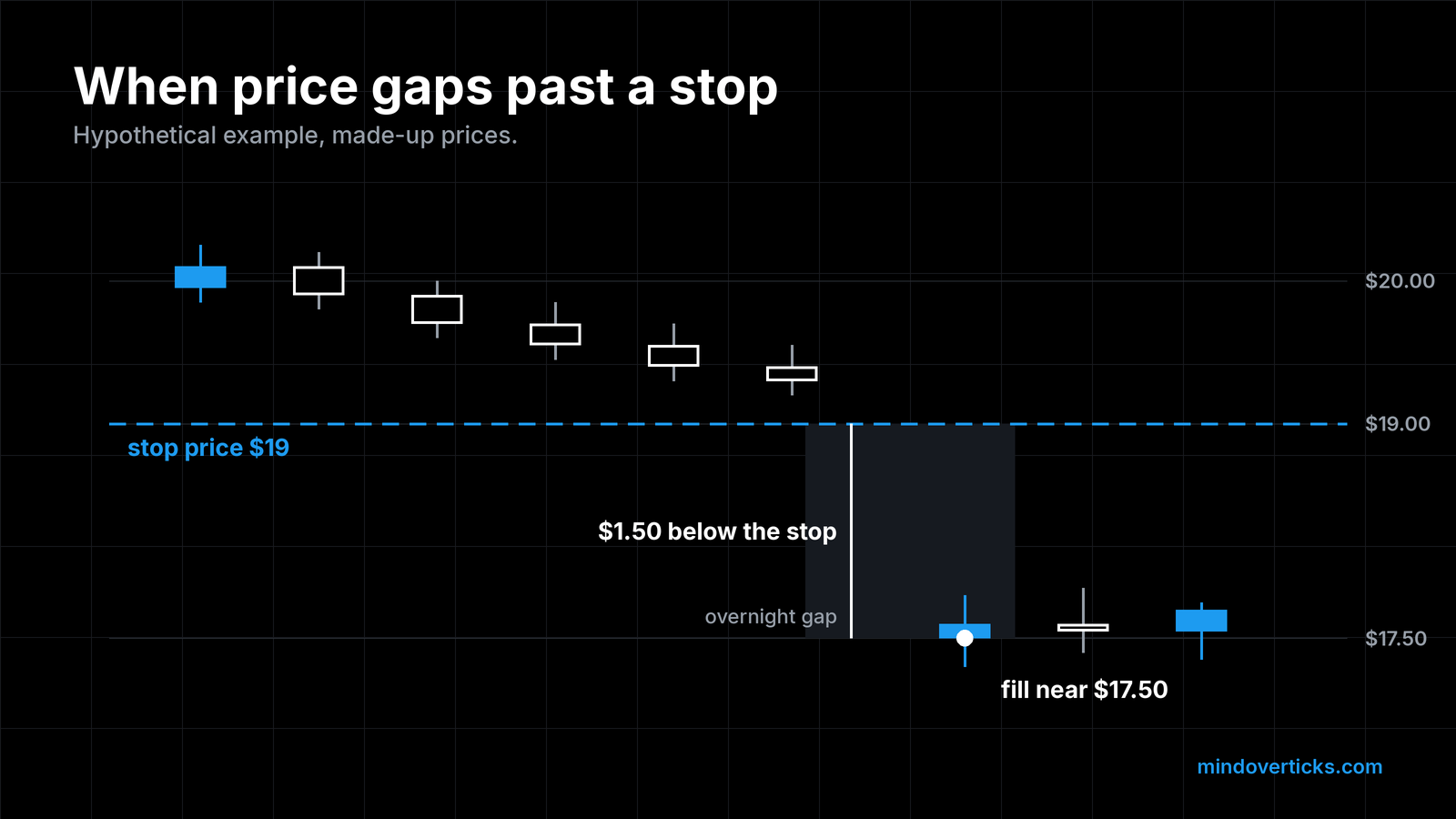
Hypothetical example (made-up prices): we own a stock at $20 with a sell stop at $19. Overnight, bad news hits, and the next trade happens at $17.50. Our stop triggers, becomes a market order, and fills somewhere near $17.50, not $19. The price gapped right past our stop, and we got out $1.50 a share worse than we planned (our math).
One more cost: noise. The bulletin warns that “short-term market fluctuations in a stock’s price can activate a stop order” (Investor.gov bulletin). A quick dip can take us out right before a bounce.
Stop limit orders: a trigger with a price cap
What if we want the trigger but not the surprise fill? That’s a stop limit. FINRA’s rule defines it: “A ‘stop limit order’ is an order to buy (or sell) that becomes a limit order to buy (or sell) at the limit price when a transaction occurs at or above (below) the stop price” (FINRA Rule 5350).
It fixes one cost by bringing back another. The SEC’s bulletin: “An investor can avoid the risk of a stop order executing at an unexpected price by placing a stop-limit order, but the limit price may prevent the order from being executed” (Investor.gov bulletin).
In our gap example, a stop limit at $19 with a $18.80 limit (hypothetical) simply wouldn’t fill at $17.50. We’d avoid the bad fill, and we’d still be holding the stock, unless the price climbs back to $18.80 or higher.
One small detail worth checking: “Different trading venues and firms have different standards for determining whether a stop price has been reached. Some use only last-sale prices to trigger a stop order, while others use quotation prices” (Investor.gov bulletin). Our broker’s help pages should say which one it uses.
So which one do we use?
There’s no single right answer, and that’s the good news: we just need to know what we care about most right now.
| If what matters most is… | The order that fits | The cost we accept |
|---|---|---|
| Getting filled, now | Market | The spread, and a price that may differ from the last trade |
| Not paying more (or selling for less) than a set price | Limit | It may never fill |
| An automatic exit or entry at a level | Stop | Can fill well away from the stop in fast moves or gaps; can be set off by short dips |
| A trigger without a surprise fill | Stop limit | It may not fill at all |
Table summarizes the Investor.gov and FINRA definitions quoted above.
A nice habit: before we click, say out loud which cost we’re choosing. “I’m paying the spread to be sure I’m in.” Or, “I’m OK missing it if it doesn’t come to me.” It sounds small, and it makes the order a decision instead of a reflex.
Once we’re in, the chart starts talking. If reading bars is new, our guide to what a candlestick actually tells you is a friendly place to start.
So here’s our question for you: which order type do you reach for most, and has one ever surprised you, a stop that filled way lower or a limit that missed by a penny? Tell us in the replies.
Mind Over Ticks publishes general education, not personalized investment advice. We do not know your situation. Talk to a licensed professional before acting. Nothing here is a trading rule or a recommendation.
Drafted with AI assistance, then fact-checked and edited by the Mind Over Ticks team.
Up next · 6 minPatience Pays: The Trades You Don't Take