Mind
ICT Macros vs Market Data: What's Really on the Clock
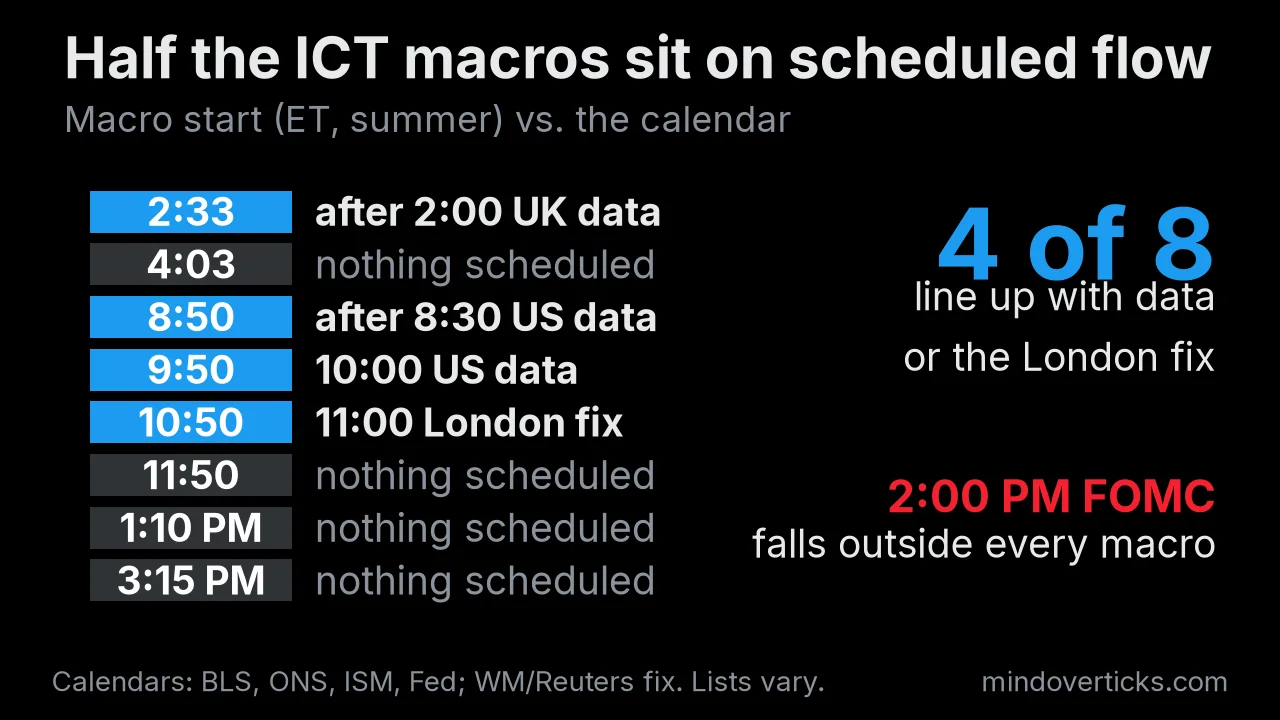
Some ICT macros sit right on top of the economic calendar. Some sit on nothing. Knowing which is which is the whole edge.
Contains affiliate links; we may earn a commission at no cost to you (details). Educational only, not financial advice (disclaimer).
The 8:50 macro is famous for “random” stop runs. It starts twenty minutes after CPI, payrolls and PPI hit the tape at 8:30 a.m. Eastern.
That’s not random. That’s the calendar.
The macro list
ICT macros are short windows on the New York clock where price supposedly runs liquidity. The list most sites agree on:
2:33-3:00, 4:03-4:30, 8:50-9:10, 9:50-10:10, 10:50-11:10, 11:50-12:10, 13:10-13:40, 15:15-15:45 ET.
Sources agree on the times more than the names, and some lists shift a window by a few minutes. Treat it as one configuration, not a law.
The data clock, session by session
Here’s when the market-moving numbers actually drop, from the agencies’ own calendars. ET shown for summer (EDT); see the DST note below.
| Session | Release | Local time | ET (summer) |
|---|---|---|---|
| Sydney | ABS CPI, jobs | 11:30 a.m. | 9:30 p.m. |
| Sydney | RBA decision | 2:30 p.m. | 12:30 a.m. |
| Tokyo | Japan data, BoJ minutes | 8:50 a.m. | 7:50 p.m. |
| Tokyo | BoJ decision | no fixed time | varies |
| Beijing | NBS PMI, activity data | 9:30-10:00 a.m. | 9:30-10:00 p.m. |
| London | UK CPI, GDP, jobs (ONS) | 7:00 a.m. | 2:00 a.m. |
| London | Eurozone flash HICP (Eurostat) | 11:00 a.m. CET | 5:00 a.m. |
| London | BoE decision | 12:00 p.m. | 7:00 a.m. |
| New York | CPI, PPI, NFP, retail sales, GDP, claims | 8:30 a.m. | 8:30 a.m. |
| New York | Cash equity open | 9:30 a.m. | 9:30 a.m. |
| New York | ISM, UMich, new home sales | 10:00 a.m. | 10:00 a.m. |
| New York | EIA crude inventories (Wed) | 10:30 a.m. | 10:30 a.m. |
| New York | FOMC statement, then presser at 2:30 | 2:00 p.m. | 2:00 p.m. |
Where the thesis holds
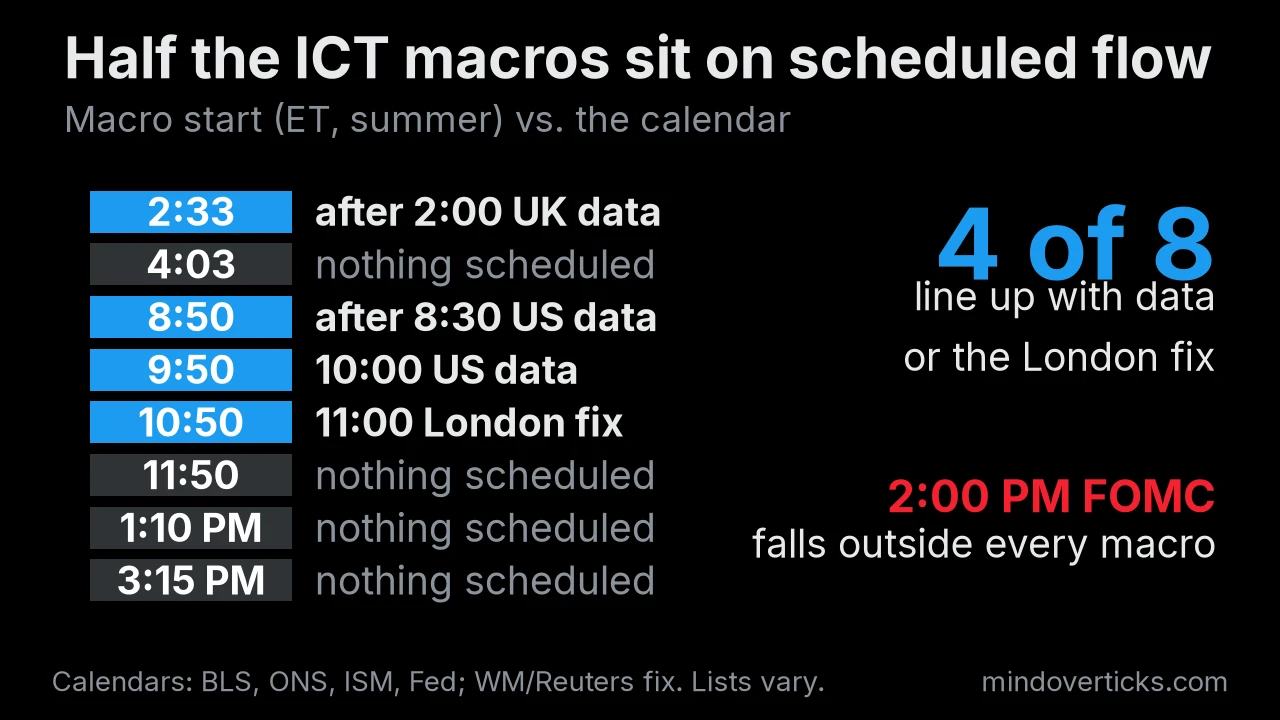
8:50-9:10. Twenty minutes after the 8:30 data, twenty before the cash open. The first reaction is done, the open is coming, and stops from the spike are sitting right there.
9:50-10:10. Straddles the 10:00 releases (ISM, UMich, JOLTS on their days). Also twenty minutes after the cash open, when the opening rush settles.
2:33-3:00. Starts half an hour after 7:00 a.m. UK data and sits right before 8:00 a.m. London.
10:50-11:10. No US data, but it wraps 11:00 ET, which is 4:00 p.m. in London most of the year: the London close and the FX fix crowd.
Where it doesn’t
4:03, 11:50, 13:10 and 15:15 have no regular scheduled release. They’re about session rhythm: late London, lunch, the afternoon restart, the run into the close.
And the biggest scheduled event of all, the 2:00 p.m. FOMC decision, sits outside every macro. So does the 10:30 EIA report and every Asian release.
Fair verdict: roughly half the macros hug a known liquidity event. The rest are time-of-day habits.
DST will wreck your timeline
The US, UK and EU change clocks on different dates. Australia runs daylight time in the opposite half of the year. Japan and China don’t change at all.
So ABS data at 11:30 a.m. AEDT is 7:30 p.m. EST in January, but 9:30 p.m. EDT in July. Japan’s 8:50 a.m. is 7:50 p.m. EDT, 6:50 p.m. EST. Your “Asia macro” moves even when the data doesn’t.
Why it “works” (and the trap)
Volume clusters at scheduled events. US equity volume is U-shaped through the day, heavy at the open and close (Jain & Joh, 1988). More orders, more stops, bigger candles. Any window parked next to that will look like it has powers.
The trap is the clock becoming the setup. You start taking trades because it’s 9:50, not because price did anything. That’s a coin flip with a fancy name.
Flip it around. Open the calendar first. Know what’s dropping and when. Then let the macro tell you when to pay attention, and let structure tell you whether to act. (More on that in Price and Time in Trading.)
On a day with no 8:30 number, watch how quiet 8:50 gets. That tells you everything. Next read: FOMO in Trading.
What are the ICT macro times?
The commonly listed eight windows in New York time are 2:33-3:00, 4:03-4:30, 8:50-9:10, 9:50-10:10, 10:50-11:10, 11:50-12:10, 13:10-13:40 and 15:15-15:45. Lists vary by a few minutes depending on the source.
Are ICT macros just economic news times?
Partly. The 8:50 and 9:50 windows sit right after the 8:30 US data and around the 10:00 releases, and 2:33 follows 7:00 UK data. But 4:03, 11:50, 13:10 and 15:15 have no regular scheduled release, and the 2:00 PM FOMC decision falls outside every macro.
What time is US economic data released?
CPI, PPI and the jobs report come out at 8:30 a.m. Eastern. ISM and University of Michigan sentiment come out at 10:00 a.m. The EIA crude report is usually Wednesday at 10:30 a.m., and FOMC decisions at 2:00 p.m.
Do daylight saving changes affect these times?
Yes. The US, UK, Europe and Australia switch clocks on different dates, and Japan and China don't switch at all, so Asian and European releases shift by an hour in New York time during parts of the year.