Mind
How to Stop Overtrading: Fewer Clicks, Better Trades
Your edge shows up a few times a day. Your itchy finger shows up every five minutes. Here's how to tell them apart.
Contains affiliate links; we may earn a commission at no cost to you (details). Educational only, not financial advice (disclaimer).
The open was good. You caught one clean move, took your profit, and you were up for the day by 9:50.
Then the market went quiet.
So you took a little scalp. Then another one, because the first one sort of worked. Then a breakout that wasn’t really a breakout. By lunch you’d taken fourteen trades, and the green from that first one was gone.
Nothing dramatic happened. No huge loss. Just a slow leak, one “eh, why not” at a time.
That’s overtrading. It’s quieter than revenge trading, which is part of why it sticks around so long. It doesn’t feel like a mistake while you’re doing it. It feels like working.
What overtrading actually is
Overtrading isn’t about a number. Some good traders take thirty trades a day. Some take three a week.
Overtrading is taking trades your plan didn’t ask for.
That’s it. If your setup showed up six times and you took six trades, you’re fine. If it showed up twice and you took eleven, nine of those trades were you, not the market.
Why more trades usually means less money
Every trade costs something before it even starts. Commissions. The spread. A bit of slippage. On one trade it’s nothing. On fifteen a day, five days a week, it adds up to a real number.
But the costs aren’t even the main problem. The bigger issue is quality.
Your best setups don’t show up on command. When you trade more than your edge allows, you aren’t adding more of your best trades. You’re adding your worst ones. The B-minus stuff. The “close enough.” So each extra trade drags your average down.
This isn’t just theory. In a well-known study of tens of thousands of brokerage accounts from 1991 to 1996, Brad Barber and Terrance Odean found that the households that traded the most earned 11.4% a year, while the market returned 17.9%. A follow-up study found men traded about 45% more than women, and it cost them more in returns. Sorry, fellas.
Here’s what that looks like on a chart:
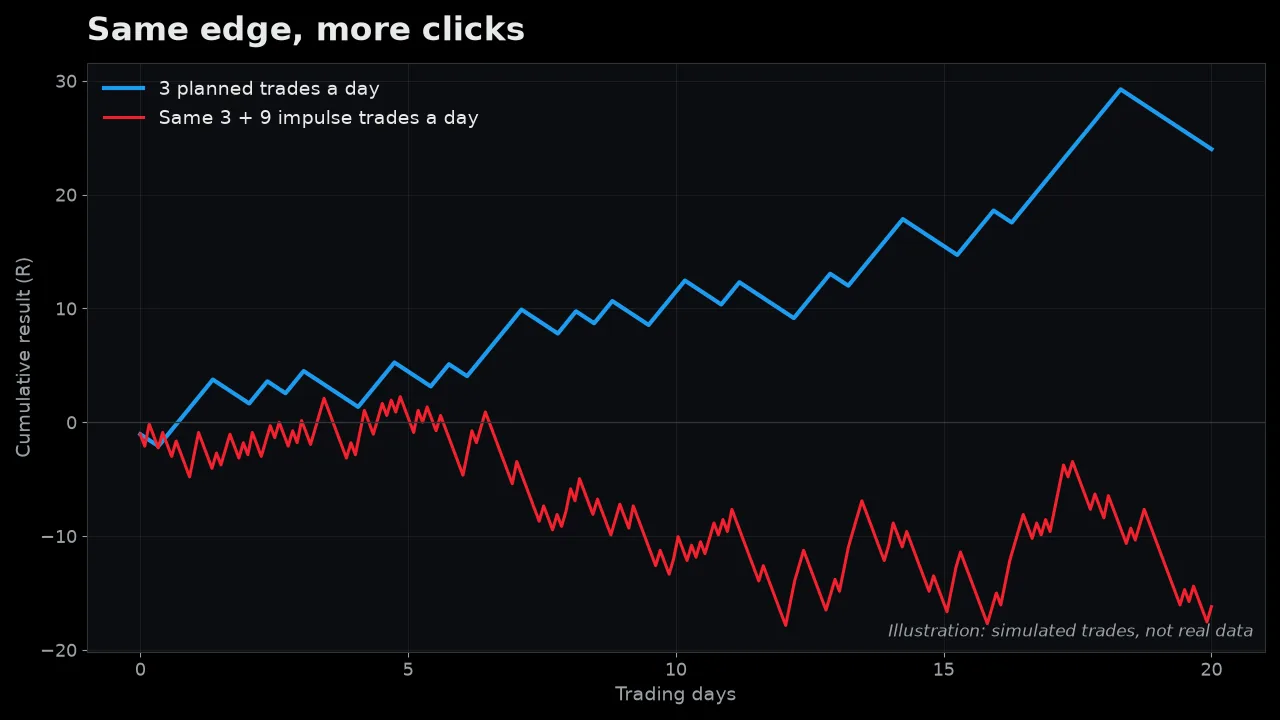
Both lines take the exact same planned trades. The red line just adds nine “why not” trades a day with slightly worse odds. That’s enough to turn a solid month into a losing one.
The four reasons you click too much
Overtrading almost always comes from one of these. Figure out which one is yours.
1. Boredom. The market is slow, you’ve been staring at it for two hours, and doing nothing feels like failing. So you make something happen. The chart didn’t give you a reason. Your restlessness did.
2. Chasing a loss. You’re red and want to be flat before you log off. Every trade becomes a “make it back” trade. This is where overtrading and revenge trading blur together.
3. Feeling invincible. You just nailed three in a row. Now everything looks like a setup. Confidence is good. Confidence that turns your standards into suggestions is not.
4. Fear of missing out. Every candle feels like the one that’s going to run without you. If that one hits home, our post on FOMO in trading goes deeper.
The common thread: the trade is about how you feel, not what the market is doing.
How to tell if you’re doing it
You might not be sure. That’s normal. Overtrading hides well because each single trade looks reasonable.
So zoom out. Pull up your last 50 to 100 trades and check:
- Trade number vs. result. Split each day into your first three trades and everything after. Compare the average result. If trade #4 and later are clearly worse, there’s your leak.
- Time of day. Lots of traders make their money in the first hour or two, then give it back in the midday chop.
- Time between trades. A cluster of entries a few minutes apart is a red flag. That’s rarely analysis. That’s itch.
- Setup tag. If a big chunk of your trades don’t fit any setup in your plan, you have your answer.
You can do this in a spreadsheet. A journal app makes it a lot faster, since it can sort by hour, day, and tag for you.
If you don’t journal at all yet, start there. Here’s a simple way to keep a trading journal that tracks your head, not just your P&L.
How to stop overtrading
Willpower isn’t the fix. You won’t out-think the urge at 11:40 a.m. on a dead Tuesday. You need rules that do the thinking for you before the session starts.
Set a max trades per day. Use your journal to pick the number. If your first three trades carry your results, your cap is three. When you hit it, you’re done. Treat it like a stop loss, not a goal.
Write down the A+ setups. Be specific. “Pullback to the prior day’s value area high after an open drive” is a setup. “Looks strong” is not. If it’s not on the list, it’s not a trade.
Stop staring at the chart. This one’s underrated. The longer you watch every tick, the more trades you’ll find that aren’t there. Mark your levels before the open, set price alerts, and step away. Let the alert pull you back when price actually gets somewhere interesting.
Add friction. Before every entry, say out loud or write one line: which setup this is, where the stop is, and why now. If you can’t do it in ten seconds, skip it. That small pause is often enough to break the autopilot.
Have a quit time. If your best hours are 9:30 to 11:30, close the platform at 11:30. Not “check back after lunch.” Closed.
Check your mood after big moves. After a big win or a big loss, take five minutes away from the screen before the next trade. Both make you trade looser. For more habits like this, see our trading discipline tips.
Doing nothing is a skill
This is the part nobody tells you. Sitting on your hands while the market wiggles is a skill, and it’s a hard one.
Trading feels like it should reward effort. More screen time, more trades, more money. It doesn’t work that way. You get paid for being right on good setups, not for being busy.
The trader who takes two clean trades and goes to the gym usually beats the guy who takes twenty and stares at the screen until close. Not because he’s smarter. Because he isn’t paying for his boredom.
Quick recap
- Overtrading means taking trades your plan didn’t call for, not a specific number.
- Extra trades are usually your worst ones, and costs add up fast.
- The usual causes: boredom, chasing a loss, overconfidence, and FOMO.
- Check your journal for where results drop off by trade count and time of day.
- Use a daily trade cap, a written setup list, alerts instead of staring, and a hard quit time.
- Doing nothing on a slow day is part of the job.
Educational content, not financial advice. See our disclaimer.
FAQ
What is overtrading?
Overtrading is taking more trades than your plan actually calls for. It usually means trading setups that are only kind of there, trading out of boredom, or trading to fix your mood after a loss or a big win.
How many trades a day is too many?
There's no universal number. Too many is any trade your plan didn't call for. Look at your own journal: if your extra trades have a worse win rate or average result than your first few, that's your ceiling.
Is a max trades per day rule a good idea?
For most discretionary traders, yes. A hard cap forces you to save your bullets for the best setups. Set it from your journal data, write it down before the open, and treat it like a stop loss.
Up next · 5 minAuction Market Theory Explained: Value Area, POC and Why Price Moves