 Mind
GLOBEX · Basics
Globex: The 24 Hour Markets
The stock market closes at 4 PM. The futures market barely blinks. This series is about everything that happens in between.
· 5 min read
Educational only, not financial advice. See the full Disclaimer.
Check S&P 500 futures at 9 PM on a weeknight. The price is still moving.
Check again at 3 AM. Still moving.
That's because many futures trade on CME Globex, an electronic market that stays open almost around the clock.
This post starts GLOBEX, our series about that clock: who is trading, when, and why it matters to you.
What Globex is
Globex isn't a building. It's a computer system.
Buy and sell orders from around the world meet there electronically. Nobody has to stand on a trading floor, so it can stay open while New York sleeps.
When it's open
Take CME's E-mini stock-index futures, like the E-mini S&P 500. Their week looks like this, in New York time (ET):
- Opens: Sunday evening, 6 PM.
- Short break: one hour each weekday evening, 5 to 6 PM.
- Closes: Friday, 5 PM.
That's it. Open nearly all week, with a one-hour pause each day.
These hours don't shift when clocks change. CME sets them in Chicago time, and Chicago and New York change clocks on the same day.
Not every product follows this pattern. CME's crypto futures and options have traded 24/7 since May 29, 2026. Every contract has its own hours, so check its spec page.
The handoff: Asia, then London, then New York
Think of the trading day as a relay race.
Asia carries it first. London takes over next. New York runs the last leg. Then Asia picks it up again.

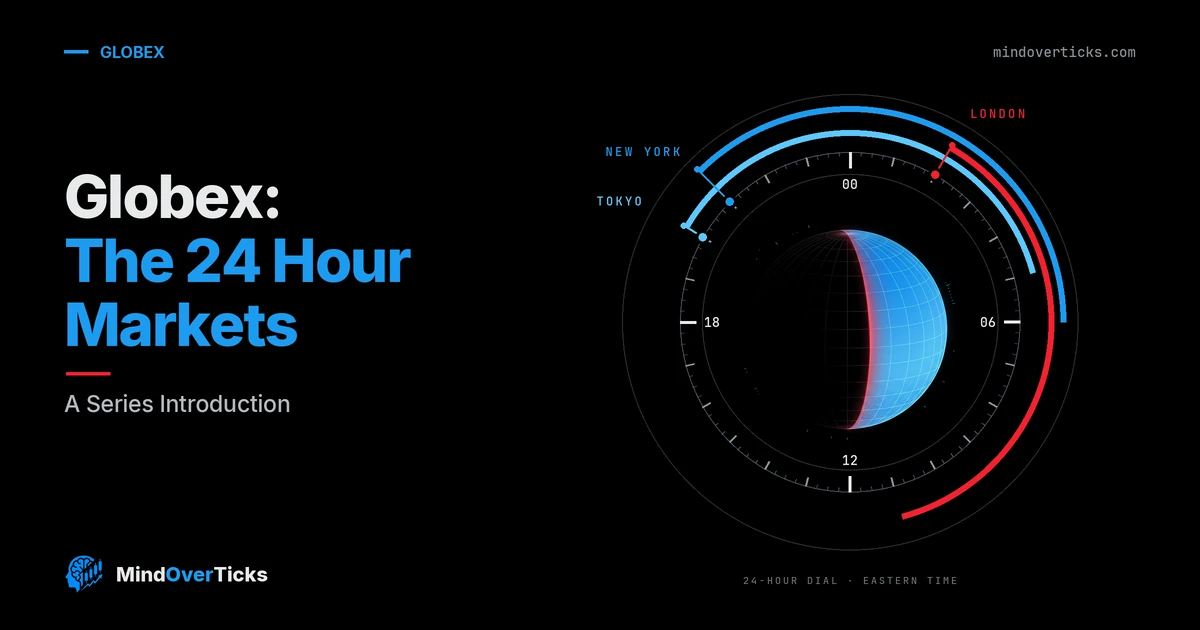
The cover shows the same idea as a 24-hour dial.
One honest note: the dots and bands on the cover are for illustration only. They are not official opening times. Different sources draw these sessions differently. Real opening times come from each exchange, and each session post in this series will cite them.
Two times we can pin down
Some Asian markets start the day with a published rate. Two of the best known:
- Tokyo. Banks set their daily currency rates around 9:55 AM Tokyo time, per SMBC.
- China. The central bank publishes the yuan's daily reference rate at 9:15 AM Beijing time (also see SAFE and CFETS).
Neither country changes its clocks:
- Japan has no daylight saving time. Japan Standard Time stays put year-round, and its official time signal always marks summer time as off.
- China stopped using summer time in 1992, by a State Council notice (text on Wikisource).
Why clock changes trip people up
The UK and the US don't change clocks on the same day.
- The UK falls back on the last Sunday of October.
- The US falls back on the first Sunday of November, one week later.
So in that gap, London is only 4 hours ahead of New York. Once both are on winter time, it's back to the usual 5.

Asia shifts too, from a New York point of view. Japan and China don't move their clocks, but New York does. So in a New York winter their morning rates land one hour earlier on a New York clock:
- Tokyo's rate: 7:55 PM ET.
- China's rate: 8:15 PM ET.
Those times hold until US clocks spring forward in March.
And south of the equator, it runs the other way: New South Wales, the Australian state that includes Sydney, moves its clocks forward in early October.
The lesson: always start from the local time, then convert. Don't trust a time you memorized last summer.
The GLOBEX Frame: one day around the world
This calendar shows what the GLOBEX series will discuss throughout. Each event will get its own explanation as the series goes on.
How to read it:
- Times are in New York time (ET). The live card below converts them to your time zone.
- The day starts Sunday evening. That's when Globex reopens, so Asia comes first.
- Impact runs 1 to 5. 5 means the event often moves markets a lot. 1 means it's a small detail.
- Exchange hours are set schedules. Data releases and central bank decisions are typically at these times, on their scheduled days only.
- Some events happen only on certain days, like weekly oil data or the monthly crop report.
GLOBEX
The GLOBEX Frame
Times update for daylight saving automatically.
This calendar shows what the GLOBEX series will discuss.
DST Shifts
Typical published times. Holidays and one-off changes happen; check the exchange or agency. Educational only, not financial advice.
The Globex frame
| ET now | Event | Impact |
|---|---|---|
| 6:00 PM | Globex weekly open (Sunday) | 4 |
| 5:00 PM–6:00 PM | Globex daily halt; new trade date starts at reopen | 3 |
Asia and Pacific
| ET now | Event | Impact |
|---|---|---|
| 4:00 PM | NZX open | 1 |
| 4:45 PM | New Zealand data | 1 |
| 6:00 PM | ASX open | 2 |
| 6:50 PM | Japan data | 2 |
| 7:00 PM | Tokyo Stock Exchange open | 3 |
| 7:00 PM | Korea Exchange open | 2 |
| 7:30 PM | Australia data | 1 |
| 7:55 PM | Tokyo FX fix | 2 |
| 8:00 PM | RBNZ decision | 1 |
| 8:00 PM | SGX open | 1 |
| 8:15 PM | PBOC yuan fixing | 3 |
| 8:30 PM | Shanghai open | 3 |
| 8:30 PM | Hong Kong open | 3 |
| 8:45 PM | Caixin PMI | 2 |
| 9:00 PM | China statistics bureau data (often around 9:30 AM Beijing; times vary) | 3 |
| 9:30 PM–10:30 PM | Tokyo lunch break / BoJ decision, usually around this break (no fixed time) | 4 |
| 10:30 PM | RBA decision | 2 |
| 10:30 PM–12:00 AM | Shanghai lunch break | 1 |
| 10:45 PM | India NSE open | 1 |
| 11:00 PM–12:00 AM | Hong Kong lunch break | 1 |
| 12:00 AM | ASX close | 1 |
| 1:00 AM | Tokyo FX option cut (by market convention) | 1 |
| 1:30 AM | Tokyo close / BoJ press conference (time varies) | 2 |
| 2:00 AM | Shanghai close | 2 |
| 3:00 AM | Hong Kong close | 2 |
| 5:00 AM | India NSE close | 1 |
Europe
| ET now | Event | Impact |
|---|---|---|
| 7:10 PM | Eurex open (futures) | 2 |
| 2:00 AM | UK and German data | 2 |
| 3:00 AM | London and Frankfurt cash open | 4 |
| 3:30 AM | SNB decision / German PMI | 2 |
| 4:00 AM | Eurozone flash PMI | 2 |
| 4:30 AM | UK PMI | 2 |
| 5:00 AM | Eurozone CPI / GDP | 3 |
| 5:30 AM | LBMA gold price AM | 1 |
| 7:00 AM | BoE decision / LBMA silver price | 3 |
| 8:15 AM | ECB decision | 4 |
| 8:45 AM | ECB press conference | 3 |
| 10:00 AM | LBMA gold price PM | 1 |
| 11:00 AM | WM/Reuters London 4 PM fix | 2 |
| 11:30 AM | London and Frankfurt cash close | 3 |
| 2:28 PM–2:30 PM | ICE Brent settlement window | 1 |
| 4:00 PM | Eurex close | 1 |
North America
| ET now | Event | Impact |
|---|---|---|
| 4:00 AM | US pre-market opens | 3 |
| 8:30 AM | Tier-1 US and Canada data | 5 |
| 9:15 AM | US industrial production | 2 |
| 9:30 AM | NYSE / Nasdaq cash open | 5 |
| 9:45 AM | S&P Global PMI / BoC decision | 3 |
| 10:00 AM | NY FX option cut (by market convention) / ISM, JOLTS, others | 4 |
| 10:30 AM | EIA inventories (crude Wed, natural gas Thu) | 2 |
| 12:00 PM | WASDE crop report (monthly) | 1 |
| 1:00 PM | Treasury auctions / Baker Hughes (Fri) / copper settle | 3 |
| 1:25 PM | Silver settlement | 1 |
| 1:30 PM | Gold settlement | 1 |
| 2:00 PM | FOMC decision (8 meetings a year) | 5 |
| 2:15 PM | Grain settlement | 1 |
| 2:30 PM | Crude/natgas settlement / Fed Chair press conference | 5 |
| 3:00 PM | Treasury and FX futures settlement | 2 |
| 3:50 PM | Market-on-close imbalance | 4 |
| 4:00 PM | US cash close / ES NQ YM RTY settlement | 5 |
| 4:30 PM | API crude inventories (Tue) | 1 |
| 5:00 PM | Globex daily close / FX New York rollover (by market convention) | 3 |
These times are for US winter: from when US clocks fall back in November until they spring forward in March. Japan, China and most of Asia move by one hour in ET; Australia and New Zealand can move by two; Europe shifts briefly when US and Europe change on different dates. The live card handles this.
Times are typical published schedules. Holidays, half-days and one-off changes happen, so check the exchange or agency before you trade around one.
What's coming in GLOBEX
We'll go around the clock, one topic at a time:
- How Globex works. Trade dates, settlement prices, busy and quiet hours, halts.
- How money moves. The dollar's daily loop and how trades settle.
- How the global economy fits together. The big economies and why currencies move.
- Session deep dives. Sydney, Tokyo, China and Hong Kong, London, New York.
- Economic data by session. What gets released, where and when.
- Forex. Daily rate fixes, option expiries, positioning data.
- Opening and closing auctions. How the first and last prices of the day are set.
- Central banks, settlement, clocks and crypto.
Each post gives exact times only from the exchange or agency that sets them.
Further reading
If you want to go deeper on how markets and trading actually work, these two books are worth your time:
- Trading and Exchanges: Market Microstructure for Practitioners by Larry Harris (Oxford University Press). It's written for people who trade. It explains who trades, how exchanges match orders, and why prices move the way they do. It's long, but each chapter stands on its own.
- Day Trading and Swing Trading the Currency Market by Kathy Lien (Wiley, 3rd edition). A former bank FX trader explains how the currency market moves through the Asian, European and US sessions. It fits the handoff this series follows.
Disclosure: As an Amazon Associate, MindOverTicks earns from qualifying purchases. Book links are affiliate links, at no extra cost to you.
Sources
- CME Group. E-mini S&P 500 contract specs (trading hours).
- CME Group. 24/7 cryptocurrency futures and options press release, June 1, 2026.
- SMBC. FX terms: Tokyo rate-setting.
- People's Bank of China. RMB central parity announcement; SAFE; CFETS.
- NICT. Japan Standard Time; JJY time code.
- State Council of China. 1992 Gazette No. 5 (PDF); Wikisource transcript.
- NIST. Daylight saving time.
- GOV.UK. When do the clocks change?
- NSW Government. Daylight saving.
The Tokyo, London and New York markers on the cover are for illustration only. They are not official opening times. Trading hours can change; check the exchange's contract page. Educational only, not financial advice. See the full Disclaimer.