 Mind
FOMO in Trading: Why the Move You Missed Stings, and What to Do Next Time
Educational only, not financial advice (disclaimer).
New to trading? Here’s the short version. FOMO means “fear of missing out.” In trading, it’s the itch we feel when a market takes off without us. We watched the setup, we hesitated, and now price is far away. The urge to jump in late, at any price, is FOMO.
Experienced traders know this feeling too. A missed move can stay with us long after the session ends. So let’s look at what the research actually says, where it stops, and what we can do the next time a chart runs away from us.
A hypothetical morning
This example is hypothetical, built to illustrate a common pattern.
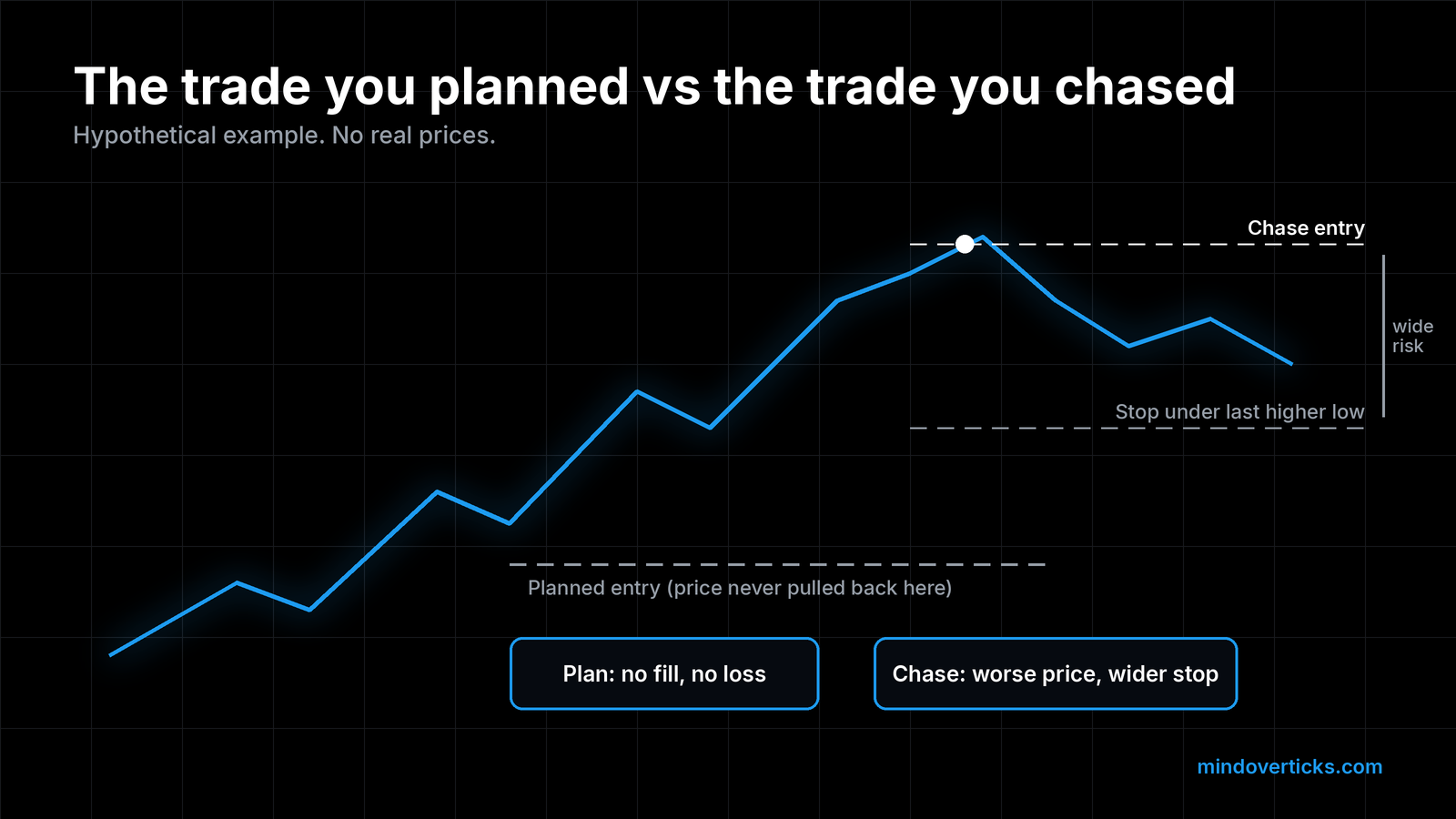
Sam has a plan: buy a pullback to a level she marked the night before. Price never quite reaches it. It stalls a few ticks above, then climbs steadily for the rest of the morning. Sam didn’t lose a cent. Her plan did exactly what it was supposed to do: it kept her out of a trade that didn’t meet her rules.
Yet by noon, Sam is replaying the open. “If I’d just bought at the market.” She starts hunting for any reason to get long, now well above her level, with a stop that would have to be far wider than she normally risks.
Nothing was lost. So why does it sting?
What the research says, and what it doesn’t
Losses usually loom larger than gains
Let’s start with the honest part. The best-known finding in this area points away from the idea that missing out hurts most. In their 1979 paper on prospect theory, Kahneman and Tversky wrote that “losses loom larger than gains,” and that “the aggravation that one experiences in losing a sum of money appears to be greater than the pleasure associated with gaining the same amount” (Kahneman and Tversky, 1979).
So we won’t claim that a missed gain hurts more than a real loss. The research we found says losses usually weigh more. What it can help explain is why a missed move lingers, and why it pulls us toward a bad trade.
Regret over inaction tends to last
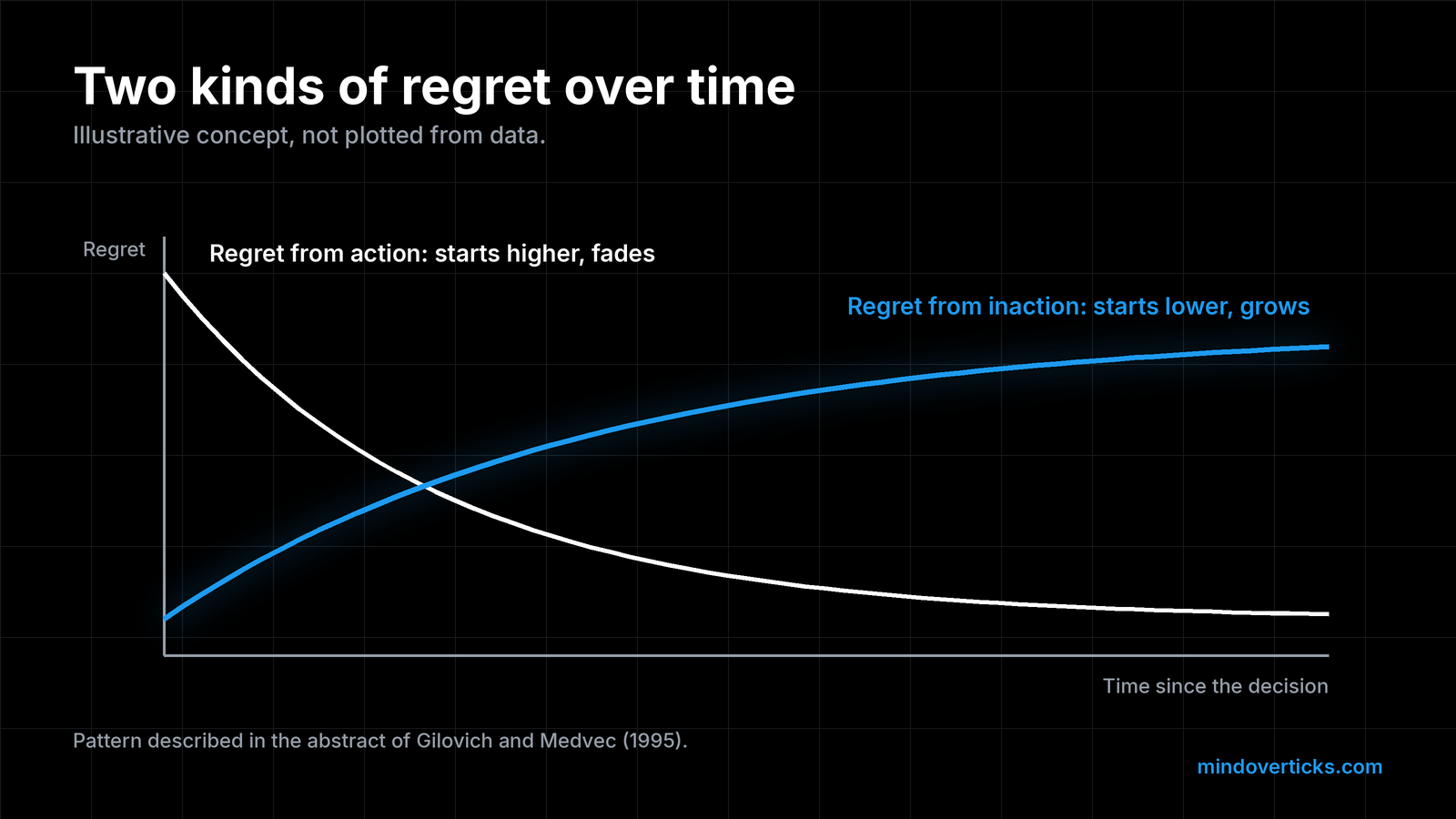
Psychologists Thomas Gilovich and Victoria Medvec reviewed the evidence on regret. The abstract reports that actions, or errors of commission, generate more regret in the short term, but inactions, or errors of omission, produce more regret in the long run (Gilovich and Medvec, 1995).
This is general research on regret in everyday life, not a study of traders, so we hold it loosely. But it fits Sam’s morning. In our view, a loss is a closed story: we did something, it didn’t work, and we can often explain it. A missed move stays open. Our minds keep running the “what if” version, and that imagined trade always worked perfectly, because it never had to survive real fills, real stops and real nerves.
The loud stocks pull us in
There’s a second force. The abstract of Barber and Odean’s “All That Glitters” reports that individual investors are net buyers of attention-grabbing stocks, such as stocks in the news, stocks with high abnormal trading volume, and stocks with extreme one-day returns (Barber and Odean, 2008). Their explanation is that buyers face thousands of choices, so whatever grabs attention gets considered first.
A market that just ran without us is, almost by definition, the loudest thing on our screen. FOMO isn’t only about regret. It’s also about where our attention gets dragged.
Why acting on FOMO tends to go badly
Put those pieces together. The missed move feels unfinished, it stays loud, and the easiest way to make the feeling stop is to get in. But the entry we’d take now is not the entry we planned. It’s later, usually at a worse price, often with a stop that’s either too tight to survive normal noise or too wide for our risk rules.
In other words, FOMO swaps a trade with an edge for a trade that mainly relieves a feeling. That’s the real cost, in our view. Not the move we missed, but the unplanned trade we take to stop thinking about it.
What to do next time
Here’s a simple routine we can run when a market leaves without us. None of this is a guarantee, and none of it is advice to buy or sell anything. It’s a way to keep the decision ours.
1. Name it out loud. Say or write “this is FOMO.” Labeling the feeling helps us treat it as information instead of an order.
2. Ask one question: is there a new setup? Not “did I miss it,” but “does my plan show a fresh entry here, with a stop and a size that fit my rules?” If yes, it’s a new trade, judged on its own. If no, we’re done. If we’re unsure which order fits a fresh entry, our guide to market, limit and stop orders can help.
3. Score the miss honestly. Did we follow the plan? If price never hit our level, the plan worked. Write that in the journal as a correct decision, even though it didn’t pay. Over time, this teaches us to grade decisions, not outcomes. 4. Shrink the screen. Since attention is part of the problem, close the chart that ran. Go back to the watchlist we built before the open.
5. Plan the re-entry before it’s needed. Some missed moves pull back. Some never do. If we want a second chance, write the conditions ahead of time: what pullback, what level, what stop. Then the next decision is made calmly, not in the heat of chasing.
6. Keep a “missed trades” log. Each week, look back. How many of the moves we missed would we actually have held to the target? This one is often humbling in a good way. The imagined trade is always perfect; the real one rarely is.
Skipping trades is a skill, and it’s one we can celebrate. Our post on the trades we don’t take tells the story of a whole day spent waiting.
So here’s our question for you: what’s the move you still think about that you didn’t take, and would you really have held it? Tell us in the replies.
Mind Over Ticks publishes general education, not personalized investment advice. We do not know your situation. Talk to a licensed professional before acting. Nothing here is a trading rule or a recommendation.
Drafted with AI assistance, then fact-checked and edited by the Mind Over Ticks team.
Up next · 6 minPosition Sizing in Plain Numbers: From Account Size to Share Count