 Mind
Fear of Pulling the Trigger in Trading: Make the Click Boring
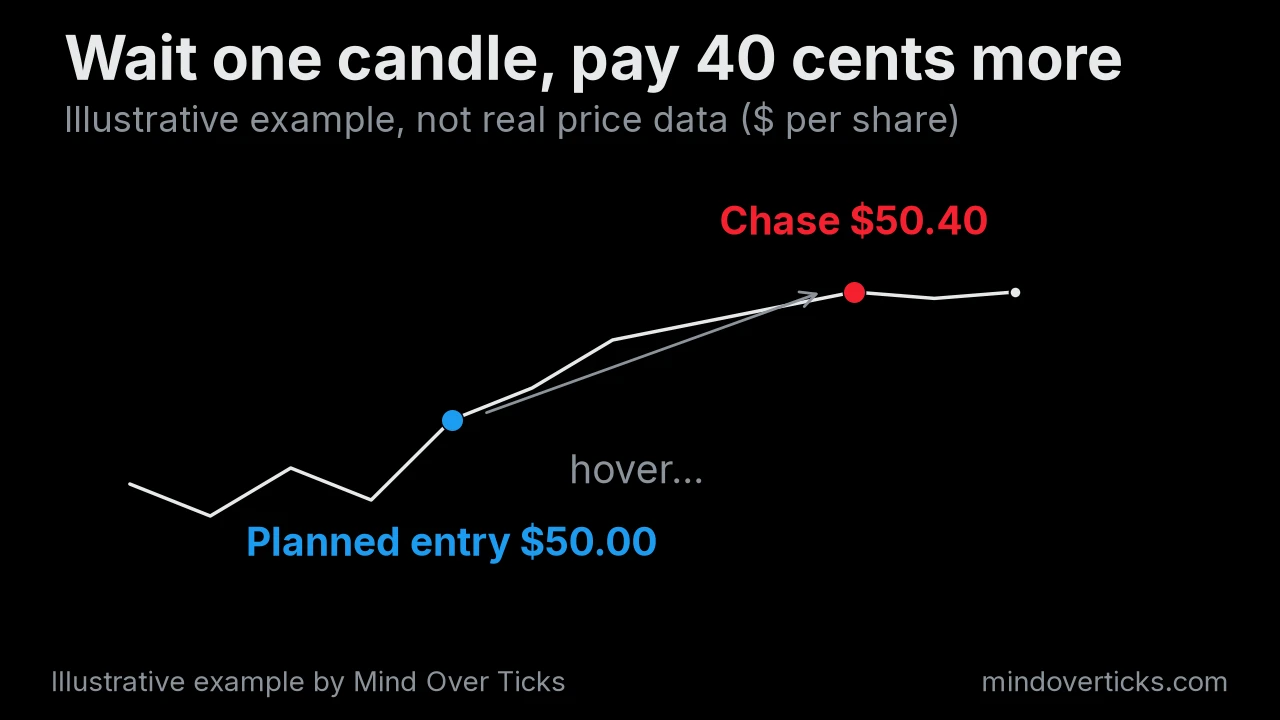
Your setup prints. Your cursor hovers. You wait one more candle. It runs without you.
Contains affiliate links; we may earn a commission at no cost to you (details). Educational only, not financial advice (disclaimer).
Fear of pulling the trigger in trading looks like this. The setup you marked last night prints. Your cursor hovers over Buy.
You wait for one more candle. It runs without you.
Then you chase it 40 cents higher, at the worst possible price. You aren’t a coward. Your brain is just keeping a weird scoreboard.
Why your finger freezes
Losses loom larger than gains.
So a loss hits roughly twice as hard as a win of the same size, in their estimate. It isn’t a law. Later meta-analyses come in lower: a mean of 1.955 across 607 estimates, and 1.31 in risky-choice data. Still, losses weigh more.
Now add blame. A loss you click into feels like your fault. A missed trade feels like nothing happened. No red on the P&L, no story to tell. Freezing wins the vote every time.
The regret flips later
Here’s the catch. Gilovich and Medvec found that actions cause more regret in the short term, while inactions cause more regret in the long run. They studied life regrets in general, not traders.
Our read for trading: a clicked loss stings today, but a week of skipped A+ setups is the regret that sticks. Those are the charts you replay on Saturday morning.
Decide before the candle
Hesitation in trading is usually a decision you never actually made. You’re deciding live, with your heart rate up and price moving.
So make it earlier. Psychologists call these if-then plans: “If Y happens, then I do X.” A meta-analysis of 94 tests found they had a medium-to-large effect on reaching goals, d = .65, and they specifically helped people start the action (free PDF).
Yours might read: “If price reclaims yesterday’s high on a 5-minute close, then I buy with a stop below the reclaim candle.”
Write it the night before, in your plan. When it happens, you aren’t deciding anything. You’re following orders you already gave. More on building that routine in our discipline tips.
Worked example: the math
Illustrative numbers, plain math:
- $10,000 account, 1% risk rule: $100 max loss.
- Entry $50.00, stop $49.50: $0.50 risk per share.
- $100 / $0.50 = 200 shares.
Your planned worst case is $100, budgeted before the open. A gap or slippage past your stop can cost more, so it’s a plan, not a guarantee.
When the size is right, the loss is boring enough to click. If $100 still makes your hand shake, cut risk to 0.5%. That’s $50, or 100 shares, while you rebuild the habit. None of this makes a trade profitable. It just makes it clickable.
Train the click
Clicking is a rep, like anything else. Take your valid setups at small size until the click feels dull.
Then log every valid setup you skipped, with one line on why. Review the list weekly. Seeing what hesitation actually cost you beats any pep talk. Our trading journal guide shows how to set it up. If fear spikes after a rough run, read how to handle a losing streak.
You don’t need more guts. You need the decision made before the setup shows up, and a loss small enough that clicking is boring.
Tonight, write one if-then entry rule and the dollar risk for your best setup. Put it where you’ll see it at the open.
Educational content, not financial advice. See our disclaimer.
Why am I afraid to pull the trigger on trades?
A loss you click into feels like your fault, while a missed trade feels like nothing happened. Research on loss aversion suggests losses weigh roughly twice as much as equal gains, so freezing feels safer in the moment.
How do I stop hesitating to enter trades?
Decide the entry and the dollar risk before the setup shows up. Write an if-then rule the night before, size the trade so the planned loss is small, and the click becomes a formality.
Should I trade smaller if I keep freezing?
Often, yes. If your planned loss still feels too big to click, cut risk (for example from 1% to 0.5% of the account) while you rebuild the habit.
More like this
How to Stop Revenge Trading: A Discretionary Trader's Protocol
One small loss. Forty minutes later, it's nine times bigger. The market didn't change. You did. Here's how to stop it.
How to Stop Overtrading: Fewer Clicks, Better Trades
Your edge shows up a few times a day. Your itchy finger shows up every five minutes. Here's how to tell them apart.

How to Handle a Losing Streak in Trading: Math First, Then Market Context
Six losers in a row feels like a sign. Run the math first. It's often just normal luck up close.