Mind
The 24-Hour Market Clock: Why Price Moves When It Does
Price doesn't move at random times. It moves when someone is forced to trade. Here's the clock.
Contains affiliate links; we may earn a commission at no cost to you (details). Educational only, not financial advice (disclaimer).
Price doesn’t wake up at 8:30 because it feels like it. It moves because someone is forced to trade at 8:30.
Every big move on your chart lines up with a clock. Learn the clock and the “random” spikes stop being random.
The volume wave
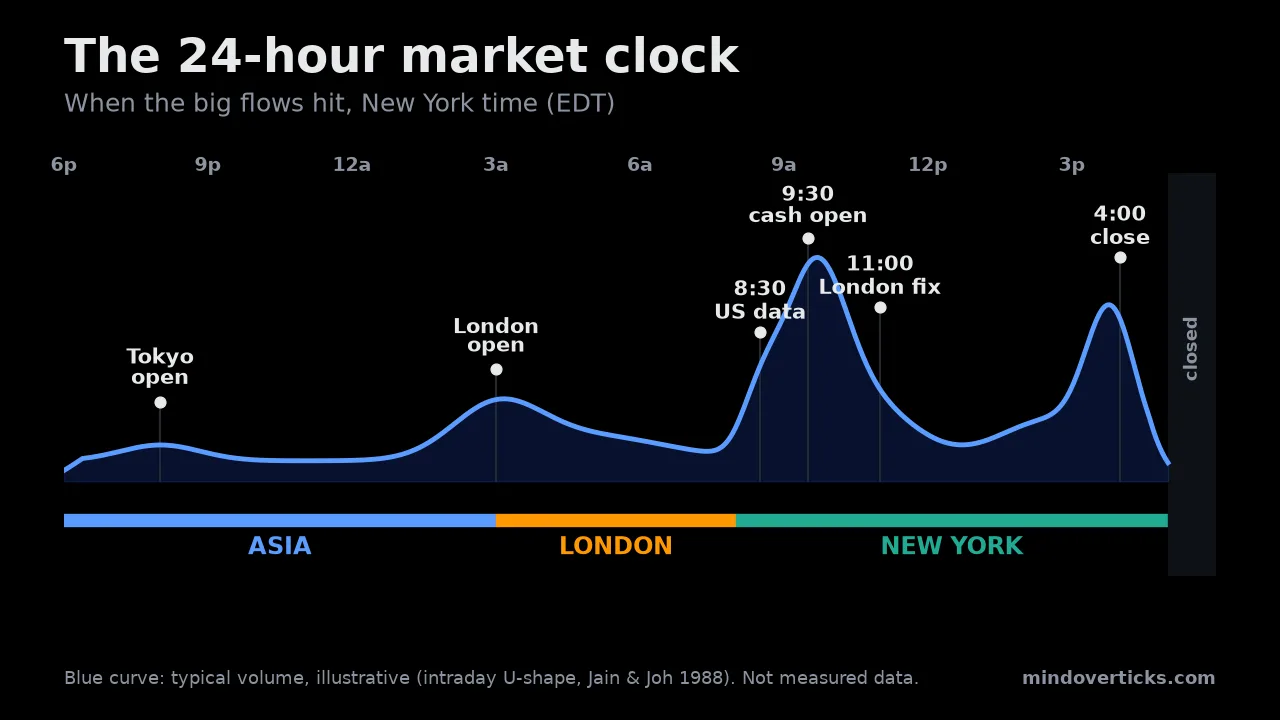
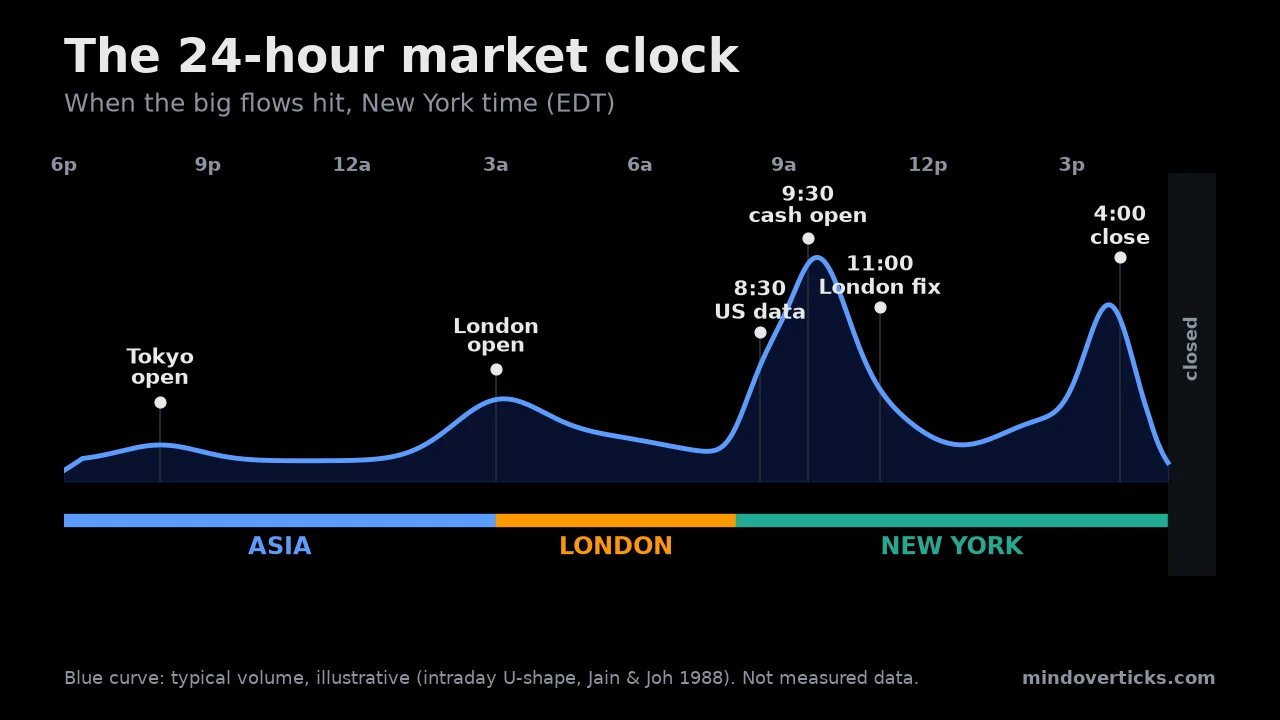
Volume breathes. It’s low through late Asia, lifts into the London open, explodes at the New York cash open, sags at lunch, then spikes into the close. That U-shape has been documented on the NYSE since Jain and Joh, 1988.
Why it matters: the same 10-tick push means nothing at 9:35 and a lot at 12:15. Size your read to the liquidity in the room.
The schedule
All times ET during US daylight time.
Globex frame (CME)
| ET | CT | Event |
|---|---|---|
| 6:00 PM Sun | 5:00 PM | Globex weekly open |
| 5:00–6:00 PM | 4–5 PM | Daily halt; new trade date at 6 PM |
Asia / Pacific
| ET | Local | Event |
|---|---|---|
| 5:00 PM | 10:00 NZDT | NZX open |
| 5:45 PM | 10:45 NZDT | NZ data |
| 7:00 PM | 10:00 AEDT | ASX open |
| 7:10 PM | 01:10 CEST | Eurex (FDAX/FESX) open |
| 7:50 PM | 08:50 JST | Japan data (Tankan, GDP, CPI) |
| 8:00 PM | 09:00 JST/KST | TSE + KRX open |
| 8:30 PM | 11:30 AEDT | Australia data (CPI, jobs) |
| 8:55 PM | 09:55 JST | Tokyo FX fix (gotobi days) |
| 9:00 PM | 14:00 NZDT | RBNZ decision |
| 9:00 PM | 09:00 SGT | SGX open |
| 9:15 PM | 09:15 CST | PBOC CNY fixing |
| 9:30 PM | 09:30 CST/HKT | Shanghai + Hong Kong open |
| 9:45 PM | 09:45 CST | Caixin PMI |
| 10:00 PM | 10:00 CST | China NBS data (CPI, IP, retail, GDP) |
| 10:30–11:30 PM | 11:30–12:30 JST | TSE lunch; BoJ decision usually here (no fixed time) |
| 11:30 PM | 14:30 AEDT | RBA decision |
| 11:30 PM–1:00 AM | 11:30–13:00 CST | Shanghai lunch |
| 11:45 PM | 09:15 IST | NSE (India) open |
| 12:00–1:00 AM | 12:00–13:00 HKT | Hong Kong lunch |
| 1:00 AM | 16:00 AEDT | ASX close |
| 2:00 AM | 15:00 JST | Tokyo FX option cut |
| 2:30 AM | 15:30 JST | TSE close; BoJ presser |
| 3:00 AM | 15:00 CST | Shanghai close |
| 4:00 AM | 16:00 HKT | Hong Kong close |
| 6:00 AM | 15:30 IST | NSE close |
Europe
| ET | Local | Event |
|---|---|---|
| 2:00 AM | 07:00 BST / 08:00 CEST | UK + German data |
| 3:00 AM | 08:00 BST / 09:00 CEST | LSE + Xetra cash open (London session) |
| 3:30 AM | 09:30 CEST | SNB decision; German flash PMI |
| 4:00 AM | 10:00 CEST | Eurozone flash PMI |
| 4:30 AM | 09:30 BST | UK PMI |
| 5:00 AM | 11:00 CEST | Eurozone data (CPI flash, GDP) |
| 5:30 AM | 10:30 BST | LBMA gold AM |
| 7:00 AM | 12:00 BST | BoE decision; LBMA silver |
| 8:15 AM | 14:15 CEST | ECB decision; ECB FX ref rates |
| 8:45 AM | 14:45 CEST | ECB presser |
| 10:00 AM | 15:00 BST | LBMA gold PM |
| 11:00 AM | 16:00 BST | WM/Reuters London 4pm fix (month-end = biggest) |
| 11:30 AM | 16:30 BST / 17:30 CEST | LSE + Xetra close |
| 2:28–2:30 PM | 19:28–19:30 BST | ICE Brent settle |
| 4:00 PM | 22:00 CEST | Eurex close |
North America
| ET | CT | Event |
|---|---|---|
| 4:00 AM | 3:00 AM | US equity pre-market opens |
| 8:30 AM | 7:30 AM | Tier-1 US/CA data: NFP, CPI, PPI, retail, GDP, claims (Thu), CA jobs/CPI |
| 9:15 AM | 8:15 AM | Industrial production |
| 9:30 AM | 8:30 AM | NYSE/Nasdaq cash open; ES/NQ quarterly SOQ |
| 9:45 AM | 8:45 AM | S&P Global PMI; BoC decision |
| 10:00 AM | 9:00 AM | NY FX option cut; ISM, JOLTS, UMich, Conf Board, home sales |
| 10:30 AM | 9:30 AM | EIA crude (Wed) / EIA nat gas storage (Thu) |
| 12:00 PM | 11:00 AM | WASDE (monthly) |
| 1:00 PM | 12:00 PM | Treasury auction results; Baker Hughes (Fri); copper settle |
| 1:25 PM | 12:25 PM | Silver settle |
| 1:30 PM | 12:30 PM | Gold settle |
| 2:00 PM | 1:00 PM | FOMC statement / minutes / Beige Book |
| 2:15 PM | 1:15 PM | Grains settle/close |
| 2:30 PM | 1:30 PM | CL/NG settle (2:28–2:30); Fed Chair presser |
| 3:00 PM | 2:00 PM | Treasury + FX futures settle |
| 3:50 PM | 2:50 PM | MOC imbalance publication |
| 4:00 PM | 3:00 PM | Cash close + ES/NQ/YM/RTY settle |
| 4:30 PM | 3:30 PM | API crude (Tue) |
| 5:00 PM | 4:00 PM | Globex daily close; FX NY close/rollover |
DST shifts. Oct 25, 2026: UK/EU fall back, so Oct 26–30 every European time is +1h in ET (London open 4:00 AM, 4pm fix 12:00 PM). Nov 1, 2026: US falls back to EST and European times return to the values above. Japan, China, HK, SG, India and Korea (no DST) move −1h in ET (Tokyo fix 7:55 PM, PBOC 8:15 PM). AU/NZ, in DST until April, also move −1h (ASX open 6:00 PM). CME/Globex is fixed in CT, so no change in ET.
Why each event moves price
Data releases. An information shock. Expectations get repriced in seconds. Market makers pull quotes before the number, so the book goes thin, and the first move sweeps whatever stops sit closest.
Cash opens and closes. Orders pile up overnight and hit at once. Opens run as auctions, and the close has the MOC imbalance at 3:50, which tells you who still has to get filled by 4:00.
FX fixes and option cuts. Funds benchmark to the fix, so banks must execute size inside a short window. Near an option cut, dealers hedge strikes, and price often gets pinned to a big strike, then released right after.
Futures settlements. Exchanges mark every open position to the settle price. Anyone managing margin, hedges or benchmarked funds wants a fill in that window. Gold, crude and bonds all get a flow burst on schedule.
Central bank decisions. Two stages. The statement drops and price reacts to the headline. Then the presser reprices the tone, and that second leg often reverses the first.
Lunches and halts. Liquidity leaves the room. Moves are smaller and fakeouts are cheaper to print, so don’t treat a lunch breakout like a 9:35 breakout.
How the reaction usually plays out
- Compression. Range tightens into the event as traders wait and quotes thin out.
- Spike or sweep. The event hits and price runs the nearest pool of stops, often both sides.
- Acceptance or reversal. If price holds and builds volume beyond the old range, it’s accepted. If it snaps back inside, the sweep was the trade, just in the other direction.
That third step is where you make or lose your money. Wait for it.
Where ICT macros fit
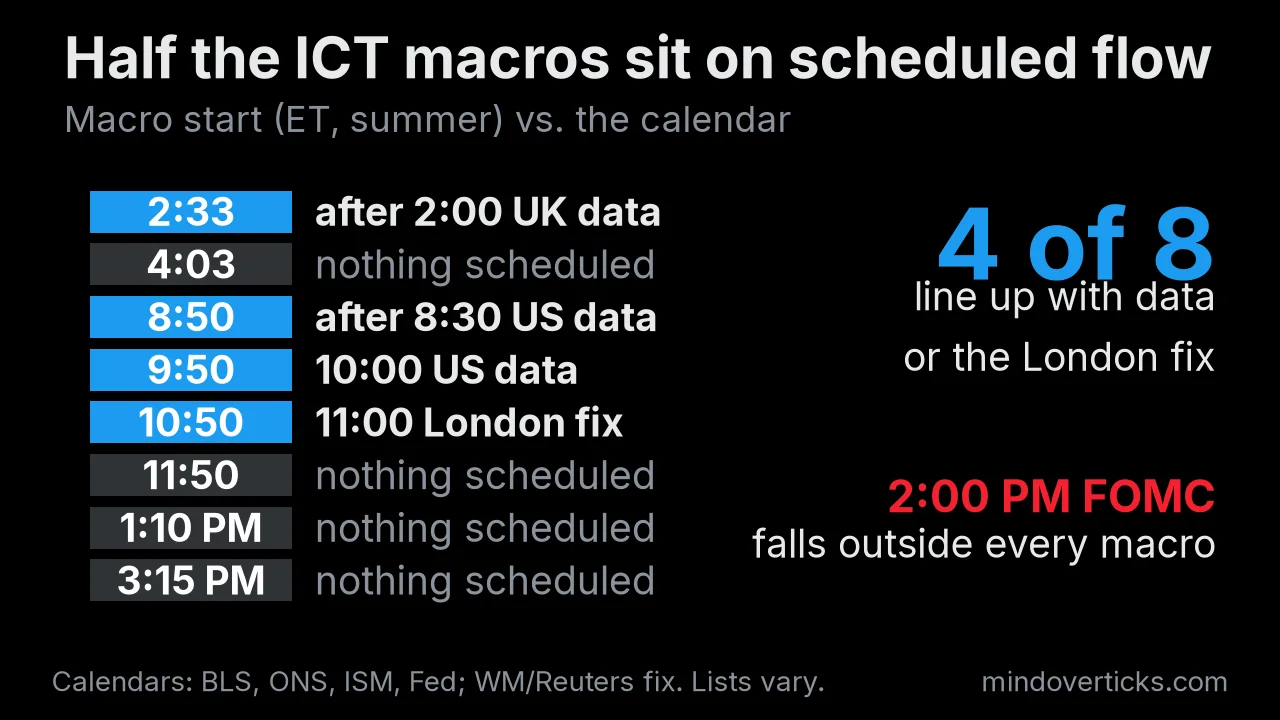
Plenty of ICT macro windows are just this clock with a new name. 8:50 and 9:50 bracket the 8:30 and 10:00 data. 10:50–11:10 wraps the London 4pm fix. 13:10–13:40 holds the gold settle. I broke down which ones line up in ICT Macros vs Market Data.
For the auction side of acceptance vs rejection, read Fair Price and Auction Theory, Simplified.
Why does price spike at the same times every day?
Scheduled events force trading: data releases reprice expectations, cash opens release overnight orders, FX fixes and option cuts concentrate benchmark and hedging flow, and settlements mark positions. Liquidity clusters around those minutes.
When is trading volume highest in futures?
Around the US cash open at 9:30 a.m. ET and the 4:00 p.m. cash close, with smaller bumps at the London open and the Asian opens. Volume dips at the New York lunch hour and is lowest in late Asia.
What time is the London 4pm fix in New York time?
11:00 a.m. ET when both the US and UK are on daylight time. During the gap weeks after the UK falls back and before the US does, it moves to 12:00 p.m. ET.
Do ICT macros line up with these events?
Several do. The 8:50 and 9:50 windows bracket the 8:30 and 10:00 data, 10:50-11:10 surrounds the London 4pm fix, and 13:10-13:40 wraps the gold settle.